By Evan Gray September 10, 2026
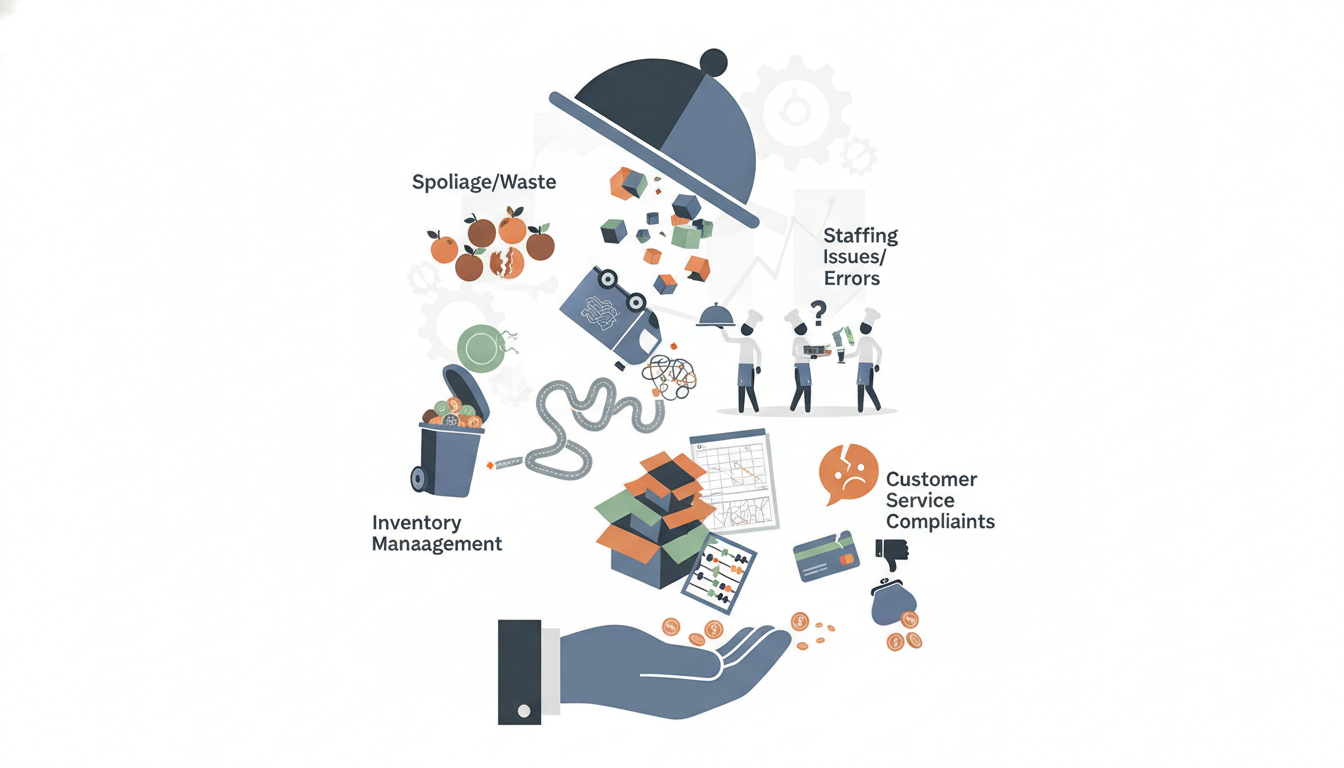
Money leaves caterers through five doors: unpriced plates, weak deposit terms, card processing fees, holding failures in transit, and labor hours nobody budgeted.
Catering Problems and Solutions, Ranked by What They Cost
Each failure removes cash by a different mechanism, and each one leaves a paper trail you can pull today.
| Failure | How the money leaves | Where to confirm it |
|---|---|---|
| Per-head price set before the plate is costed | Food and labor eat the margin you assumed was there | Recipe costing sheet against the event invoice |
| Deposit and cancellation terms that can’t survive a dispute | A canceled event becomes a chargeback you lose on paper | Signed contract and the terms shown at checkout |
| Card acceptance treated as a convenience, not a cost line | Margin skimmed off every five-figure corporate invoice | Monthly processing statement, fee by fee |
| Hot and cold holding failures on the road | Food discarded, event re-produced, or worse (“Danger Zone”) | Transport and holding temperature log |
| Labor hours scheduled but never priced | Overtime at time and one-half, or a tip-credit violation (Fact Sheet #2) | Timecards and the event labor plan |
Four of the five are documentation failures. Your cooks aren’t the problem. The costing sheet nobody updated, the contract clause nobody read, the statement nobody reconciled, and the timecards nobody compared to the schedule are where the money went. Only the holding failure is operational, and even that one gets proven or disproven by a log.
Failure 1: Quoting a per-head price before you’ve costed the plate
A caterer who prices by looking at what the shop across town charges is guessing at someone else’s cost structure. That guess survives small jobs because the margin on a fifty-guest lunch can absorb a lot of error. It doesn’t survive a 400-guest gala, where every dollar of unpriced plate cost multiplies four hundred times and the loss hides inside a big, exciting invoice.
Build the number from four buckets instead, then quote the sum:
- Raw food cost per plate, priced from this week’s invoices, not last season’s.
- Prep and service hours at a loaded wage that includes payroll taxes and any overtime you’ll owe past 40 hours in the workweek (Fact Sheet #2).
- Transport, rentals, and anything you’re renting because the venue lacks it.
- Your target margin, applied last and stated as a number you chose.
Then protect that number in the contract. You need a guaranteed minimum headcount, a final-count deadline tied to your ordering lead time, and a stated price per guest added after that deadline. Without the third clause, every late addition gets absorbed at your cost. A substitution and market-price clause does the same job for ingredients: if the halibut doubles or the heirloom tomatoes fail, you swap to a named equivalent or pass through the difference, rather than eating a shortage you didn’t cause.
Track actual cost per event against the quote after every job. One event tells you nothing. Three or four show the pattern, usually in labor hours or rental line items, and the Cost Savings With Cloud Catering Software come mostly from having that comparison ready without a spreadsheet rebuild. Small shops get there fastest, which is one of the Benefits of Using Catering Management Software for Small Businesses.
Failure 2: Deposits and cancellations that collapse into a chargeback
A corporate client books a 200-person lunch, pays a 50% deposit by card, then cancels four days out. You keep the deposit because your policy says you can. Two weeks later the deposit shows up as a dispute, coded as services not received. Unless your file proves the client saw and accepted the cancellation terms before the card was charged, the issuer pulls the money back and you’ve eaten the food cost, the staff booking and the dispute fee.
A deposit taken in March for a September wedding can be disputed in the fall, long after you’ve stopped thinking about it. Keep the evidence with the event, not in your email.
Three things make a retained deposit defensible:
- The cancellation and refund terms displayed on the same page or document as the payment, before it’s submitted.
- Timestamped proof of acceptance, whether a checked box, an e-signature, or an emailed reply agreeing to the terms.
- An itemized invoice tying the deposit amount to a named event on a specific date.
Then fix the descriptor. If your statement name is your LLC and your clients know you as something else, you’ll get disputes that no rebuttal document survives, because the cardholder genuinely didn’t recognize the charge. Put the trading name and a phone number a human answers.
A sliding schedule tied to real commitment points, the day produce is ordered, staff are booked, rentals are confirmed, reads as liquidated damages rather than a penalty. Say plainly whether the deposit is non-refundable, non-transferable, or both, and whether one date change is allowed. Our full breakdown of deposit and cancellation contract language covers the wording.
Failure 3: Paying card rates on five-figure corporate invoices
A $28,000 holiday party invoice arrives on a corporate card. You run it, the money lands, and the acceptance cost is netted out of the deposit before it ever touches your books. It never shows up in a food-cost review because it isn’t food cost. On flat-rate pricing, that single swipe costs real money, and the number is set by your pricing model and the card the client chose, not by anything you can renegotiate after the fact.
Two fixes recover the most. First, ask your processor for interchange-plus with the margin stated as one number in writing, then read the next statement line by line. Every fee has a name and a source. If nobody can give you both, change processors.
Second, send the data. Most caterers never send them, which is why the reduction goes unclaimed. Check whether your gateway passes those fields at all; our guide to catering software with integrated payments covers which platforms do.
Then set a threshold above which Getting Corporate Catering Clients to Pay Five-Figure Invoices by ACH Instead of Card becomes your default, keeping cards for deposits and small orders. And before signing anything, read the termination clause and the equipment lease. Ask whether next-day funding is included or priced, and what time the batch cuts off.
Failure 4: Losing the food between the kitchen and the venue
Off-site catering rarely fails at the range. It fails in the van, on the loading dock, and during the forty minutes a chafing dish sits before guests arrive. Food remade on site is pure loss, and food served cold is a reputation hit you pay for twice.
| Item | Threshold |
|---|---|
| Poultry, cooked | 165°F (Cook to a Safe Minimum Internal Temperature) |
| Ground meats | 160°F (Cook to a Safe Minimum Internal Temperature) |
| Whole cuts of beef, pork, lamb | 145°F plus a 3-minute rest (Cook to a Safe Minimum Internal Temperature) |
| Seafood | 145°F (Cook to a Safe Minimum Internal Temperature) |
| Reheated leftovers | 165°F (Cook to a Safe Minimum Internal Temperature) |
| Hot holding | 135°F or above (Food Code 2022) |
| Cold holding | 41°F or below (Food Code 2022) |
| Danger zone | 40°F–140°F, where bacteria multiply rapidly (“Danger Zone”) |
| Time in the zone | Discard after 4 hours; 2 hours if the food will be chilled and reused (“Danger Zone”) |
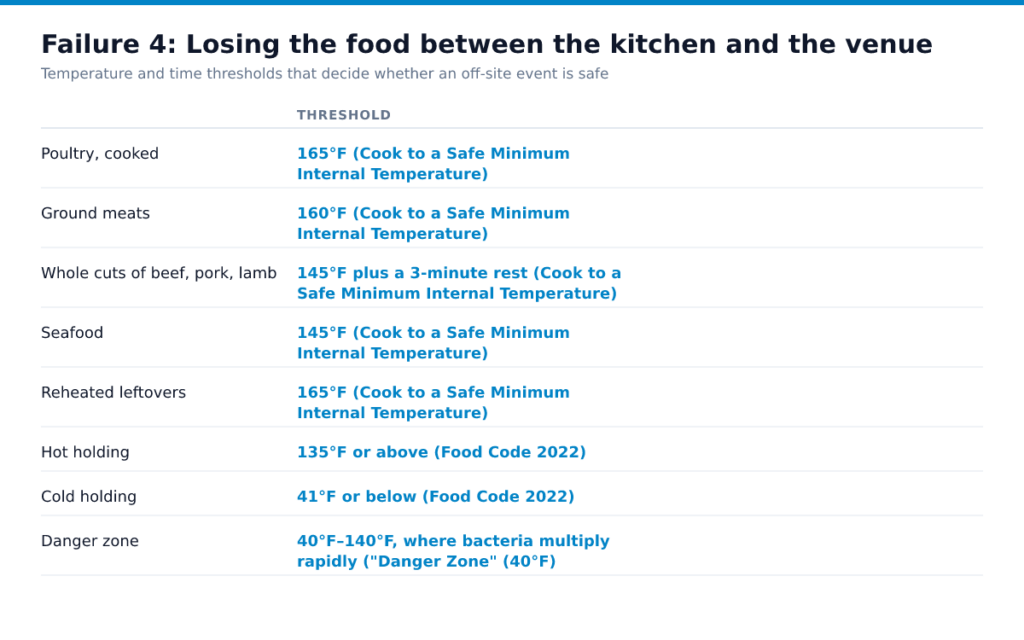
Probe and log a temperature twice, once at load-out and once at first service, with the time, the item and the initials of whoever took it. That log settles a client complaint about lukewarm chicken and it’s the first thing an inspector asks for. Without it, you’re arguing from memory.
Failure 5: Labor hours you scheduled but never priced
A crew called in at 2 p.m. for a 6 p.m. reception, held through a ceremony that ran forty minutes late, then kept for a toast the client added that morning, is a crew you’re paying past 40 hours in the workweek. Federal overtime is owed at one and one-half times the regular rate after 40 hours (Fact Sheet #2). Your quote priced eight-hour shifts. The math went with the timeline.
Schedule to the run sheet: a stated call time, a stated release time, and a contract overtime rate the client pays when their timeline slips. How to Manage Staff Scheduling with Catering Software covers the shift side; Best Practices for Catering Event Scheduling covers the timeline that drives it.
Labeling matters too. A mandatory service charge is generally not a tip under the FLSA (Fact Sheet #15), so calling it gratuity on the invoice creates an expectation you may not be meeting. Managers and supervisors can’t take tips from a pool, even when they’re carving the roast (Fact Sheet #15B). If you take a tip credit, the section 3(m) notice has to reach the employee before the shift, not after (Fact Sheet #15). Many states are stricter.
Pull your last three events and compare scheduled hours against clocked hours. If the gap is real, add an overtime clause and a call-time line to your next contract before you send it.
Frequently Asked Questions
What are the four main types of catering?
The four types most operators recognize are corporate catering, social catering (birthdays, memorials, holiday parties), wedding catering, and concession or mobile catering, though the more useful split for your cost sheet is on-premise versus off-premise. On-premise work in your own space means fixed equipment, a known kitchen, and no transport risk. Off-premise means you’re renting or hauling everything that holds temperature, and that shows up as equipment, mileage, and an extra body on the load-out. If you quote both types off one per-head number, the off-premise jobs subsidize nothing and quietly lose money.
What are current trends in the catering industry?
Three shifts are changing how catering jobs get priced: drop-off and hybrid-office catering with no service staff, heavier allergen and dietary accommodation on the same menu, and card-not-present ordering through portals and email invoices instead of a signed paper contract. Drop-off looks cheaper to produce and often isn’t, because the food still has to leave the kitchen and arrive out of the danger zone between 40°F and 140°F (USDA FSIS, “Danger Zone”), which means hot boxes and a driver you scheduled. On the labor side, service-charge and tip handling is under more scrutiny than it used to be, and managers and supervisors can’t keep tips from a pool even when they served the table themselves (DOL Fact Sheet #15B). We tell clients to treat each of these as a line on the quote, not a courtesy.