
By Evan Gray September 7, 2026
A $20,000 catering invoice creates a very different payment decision from a $200 lunch order. When card acceptance is priced as a percentage of the transaction, large catering invoice processing fees can become a meaningful event-level expense.
That is why ACH payments for catering invoices deserve special attention once corporate events reach several thousand dollars.
The opportunity, however, is not simply “ACH costs less.” A bank payment changes the workflow from quote through reconciliation.
The client has to see the bank-payment option, complete any required authorization or bank verification, fit the payment into its accounts-payable process, and submit it early enough for the caterer to manage settlement and return risk before food, labor, rentals, and logistics costs become irreversible.
Under some provider pricing models, a five-figure bank payment may cost a flat or capped amount instead of a percentage of the invoice.
Under others, ACH fees may be percentage-based, subject to minimums, caps, verification charges, return fees, or other terms. Caterers therefore need to compare their own contracts rather than rely on a supposed universal ACH price.
The strongest strategy is usually selective rather than absolute: make bank payment exceptionally easy for established corporate accounts and larger invoices, while keeping cards available where immediate authorization, client procurement rules, or a short event lead time makes card acceptance operationally valuable.
The full journey should be:
quote/event → invoice → payment choice → client selects ACH → authorization → bank settlement → return-risk monitoring → invoice reconciliation.
That sequence is what turns ACH from another payment button into a useful corporate catering payment policy.
Why ACH Payments for Catering Invoices Matter More at Five Figures
Percentage-based card pricing scales with the invoice. If a hypothetical card transaction costs 3% all-in, the dollar cost is $60 on $2,000, $300 on $10,000, $750 on $25,000, and $1,500 on $50,000.
That matters because catering revenue is not the same as catering margin.
A $25,000 event may include substantial pass-through or near-pass-through costs for proteins and produce, hourly labor, rented equipment, linens, transportation, venue requirements, subcontracted services, disposables, setup crews, and overtime.
A payment fee calculated against the full invoice can therefore consume a larger share of profit than its percentage of revenue initially suggests.
ACH can change those economics where a caterer’s provider offers flat-fee or capped bank-payment pricing. It does not follow that all ACH products use that model. Some providers charge percentages, per-transaction charges, monthly fees, verification costs, return fees, or a combination.
The useful comparison is therefore not “What does ACH usually cost?” It is:
What would this exact invoice cost through our actual card agreement versus our actual bank-payment agreement?
That distinction is critical when discussing ach vs credit card big invoices.
A controller should pull actual merchant statements and identify the effective cost associated with the relevant card types. Corporate clients may pay with purchasing cards, commercial cards, virtual cards, rewards products, or other credentials whose economics differ.
Then obtain the ACH pricing schedule from the bank, payment provider, or software platform. Confirm whether the quoted price is fixed, percentage-based, capped, tiered, or subject to additional bank-verification and return charges.
Only then can the business create a reliable threshold for when ACH deserves stronger promotion.
For catering businesses that need a broader view of invoices, deposits, and event billing, the site’s guide to catering billing and invoicing provides useful context without duplicating this large-account conversion strategy.
Why percentage-based card costs hurt on corporate events
Card acceptance remains valuable. It gives clients a familiar payment method, can provide rapid authorization, and often works smoothly for short-notice events.
The problem is simply that a percentage becomes a large number when the invoice becomes large.
Suppose the event has a $20,000 final balance. At an illustrative 3%, payment cost would be $600.
That $600 might otherwise contribute toward:
- additional event labor,
- rental expense,
- delivery payroll,
- food-cost overruns,
- post-event cleanup,
- or operating margin.
The decision becomes more important as invoice value rises because payment cost grows even if the operational effort required to collect the transaction does not grow proportionally.
A catering company should therefore treat payment method as part of event economics—not as an accounting detail handled after the event has already been sold.
Card vs. ACH Fee Math on $2,000–$50,000 Invoices

The following examples intentionally use a simple hypothetical model so the economics are easy to see:
- Illustrative card cost: 3.00% of invoice value
- Illustrative ACH cost: $15 per payment
These figures are examples only. They are not market averages, quotes, recommendations, network rates, or promises about what any caterer will pay.
Your actual card pricing may be lower or higher. Your ACH provider may charge a percentage, a different fixed amount, a cap, verification fees, monthly charges, return fees, or other costs.
Table 1: Illustrative card vs. ACH fee math
| Invoice Amount | Card Cost Example | ACH Cost Example | Difference | Difference as % of Invoice |
| $2,000 | $60 | $15 | $45 | 2.25% |
| $5,000 | $150 | $15 | $135 | 2.70% |
| $10,000 | $300 | $15 | $285 | 2.85% |
| $25,000 | $750 | $15 | $735 | 2.94% |
| $50,000 | $1,500 | $15 | $1,485 | 2.97% |
The table explains why ACH becomes strategically interesting at five figures.
On the $2,000 example, a $45 difference may be worthwhile but probably does not justify creating friction with a good client.
At $25,000, the hypothetical difference becomes $735. At $50,000, it reaches $1,485.
The savings percentage approaches the assumed card percentage because the illustrative $15 ACH cost becomes progressively smaller relative to invoice value.
That does not mean a caterer should force every large customer to use ACH. A payment method has operational value as well as processing cost.
For example, accepting a $20,000 card payment for an event tomorrow may be economically reasonable if the alternative is waiting on a bank-payment process that cannot meet the caterer’s required payment deadline.
The best analysis considers total payment cost:
processing cost + return risk + days to usable cash + collections effort + internal labor + client friction.
A payment method that costs $100 less but requires repeated AP follow-up and delays payment past purchasing deadlines may not actually be cheaper.
Why Corporate Buyers May Already Be Comfortable With Bank Payments
Corporate client bank payment adoption is often easier than consumer adoption because many businesses already use bank-based payment rails to pay suppliers.
A corporate buyer may routinely handle:
- purchase orders,
- vendor onboarding,
- tax documentation,
- invoice approvals,
- AP payment runs,
- treasury controls,
- vendor bank verification,
- and payment remittance records.
For those buyers, an ACH option can fit existing procedures rather than introduce an unfamiliar payment method.
This does not mean every corporation prefers ACH. Some companies use commercial cards deliberately because they want centralized spend controls, extended working-capital benefits, virtual-card security, expense reporting, rebates, or procurement-policy compliance.
The catering salesperson therefore needs to discover payment requirements early.
A useful question during corporate onboarding is:
“Does your AP team normally pay catering vendors by bank payment, commercial card, virtual card, or check?”
That conversation should happen while the vendor record and purchase order are being created—not three days before the event.
Vendor setup may require a W-9, proof of insurance, banking verification, procurement forms, approved supplier registration, PO number, or specific invoice fields. If those requirements are incomplete, even a perfectly designed ACH button may not produce payment.
For repeat corporate relationships, cloudcateringmanager.com’s guide to recurring billing for corporate catering accounts is a useful companion resource.
How to Offer ACH Directly on a Catering Invoice
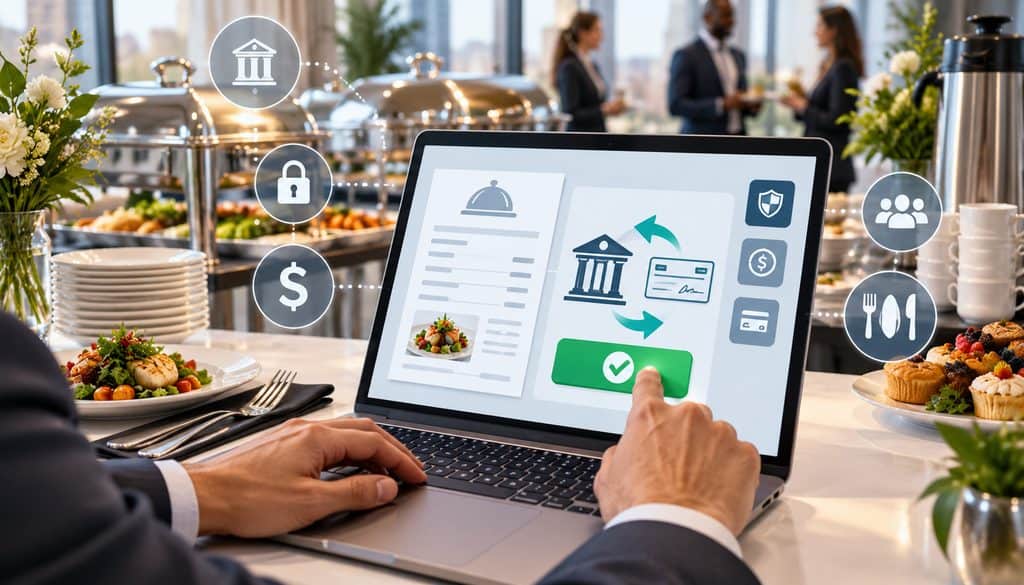
ACH adoption drops when paying by bank requires more effort than paying by card.
A client should not have to email accounting for instructions, print an unfamiliar form, telephone a bookkeeper with sensitive bank information, or manually type routing details into an ordinary email.
Instead, put the approved bank-payment workflow inside the invoice experience.
Bank-Payment Button
A hosted invoice can show a clear Pay by Bank / ACH option beside the card option.
The button should connect to the exact invoice and carry forward the information needed for reconciliation:
- client account,
- invoice number,
- event ID,
- amount due,
- due date,
- and payment reference.
The customer then enters or verifies bank details through the payment provider’s secure environment.
Avoid collecting raw bank account credentials in catering notes, ordinary email, text messages, shared spreadsheets, or contract comments.
The site’s current cloud catering software security and data protection guide similarly recommends approved hosted payment workflows instead of storing raw financial credentials in operational records.
Client Portal and Payment Links
A secure client portal is useful for repeat accounts because the AP contact can see outstanding invoices, supporting event documents, payment history, and approved payment options in one place.
For one-off events, a secure invoice-specific payment link may be simpler.
The important point is that the link resolves to the correct invoice automatically. Finance should not have to infer which $12,475 bank deposit belongs to which event later.
A good payment page clearly shows:
- catering company,
- corporate client,
- invoice number,
- event reference,
- amount,
- due date,
- supported payment methods,
- and AP contact information.
“No card number required” can be useful descriptive messaging for a bank-payment option. Avoid manipulative claims suggesting that one method is mandatory when it is not.
Repeat Account Authorization
An eCheck corporate catering payment workflow becomes particularly useful for accounts that book recurring breakfasts, training sessions, board meetings, sales meetings, or seasonal events.
Possible structures include:
- one-time authorization for each invoice,
- approval of each payment after the final event invoice,
- a repeat or standing business arrangement where permitted,
- scheduled debit only after an agreed approval event,
- or client-initiated bank payments from a recurring portal.
Nacha’s current guidance is important here. For entries to non-consumer accounts, authorization may be obtained in a manner permitted by applicable legal requirements; Nacha’s developer guidance also states that business trading partners must have an agreement and that proof of permission to transact must be available.
That does not mean a catering company has permission to debit an account whenever it wants.
The payment authorization should align with the catering contract, invoice approval, agreed event changes, and any procurement rules. If the final guest count changes a $14,000 estimated invoice to $17,800, the workflow should establish when and how that revised amount becomes approved for debit.
What Corporate ACH Authorization Must Include
For business-to-business ACH, avoid copying a consumer authorization form and assuming it answers every question.
Nacha states that authorizations for entries to non-consumer accounts may be obtained by methods permitted under applicable legal requirements. Its developer guidance says business partners need an agreement, while the Rules do not prescribe the same consumer-debit authorization content for the business agreement.
Your ODFI, payment provider, bank, software platform, applicable law, and transaction structure may impose additional requirements.
Operationally, a strong corporate bank-debit record should make it possible to demonstrate who agreed to what.
Table 2: ACH authorization documentation checklist
| Authorization Item | Why It Matters | Record to Keep |
| Legal business/customer identity | Identifies the Receiver and contracting party | Client/vendor account record |
| Caterer/originator identity | Shows who is permitted to initiate payment | Agreement or payment authorization |
| Account/payment authorization | Establishes permission to debit the designated business account | Provider authorization record |
| Amount or calculation method | Reduces disagreement about what may be debited | Invoice, schedule, or formula |
| Timing/frequency | Distinguishes one-time, repeat, and recurring arrangements | Authorization terms |
| Approval trigger | Connects payment to event/invoice approval | Approved invoice or workflow log |
| Revocation/cancellation method | Establishes how future permission can be withdrawn | Authorization terms and contact channel |
| Effective date | Shows when the arrangement began | Timestamped authorization |
| Authorized representative | Helps show who acted for the corporate customer | User/account identity and audit trail |
| Contact information | Supports questions and exception handling | AP contact record |
Those fields are best viewed as a strong documentation framework—not a declaration that Nacha universally mandates that exact list for every business ACH entry.
How long should authorization records be retained?
Nacha materials state that Originators must retain the original, a copy, or a reproducible record of authorization for two years following termination or revocation of the authorization, and maintain the ability to provide proof when requested.
Do not confuse that record-retention period with the separate timeframe for warranty claims involving unauthorized entries to non-consumer accounts. Nacha’s current limitation on warranty claims allows a claim involving an unauthorized debit to a non-consumer account for one year from the settlement date of the entry.
Because provider agreements and applicable recordkeeping laws may require longer retention, the catering company should confirm the retention policy with its financial institution or ACH provider before establishing a deletion schedule.
Records also need to be retrievable, not merely technically stored somewhere. A PDF lost inside an old salesperson’s mailbox does not create an effective exception-resolution process.
One-time event vs. repeat account authorization
| Client Type | Payment Pattern | Better ACH Setup |
| One-time corporate event | Single invoice or final balance | One-time bank payment |
| Repeat corporate client | Monthly or quarterly events | Invoice approval plus repeat authorization where appropriate |
| Contract catering account | Recurring invoices | Autopay or scheduled debit workflow where contractually and operationally appropriate |
| Variable high-value events | Different total each event | Invoice-by-invoice approval may provide clearer control |
The correct structure depends on how amounts are determined, how the client approves invoices, the provider’s ACH setup, and applicable requirements.
ACH Return Risk on Large Catering Payments
The biggest mistake in ach return risk catering is treating an ACH deposit as if the presence of money in the caterer’s account means all possibility of return has disappeared.
ACH has a returns framework that is different from card chargebacks.
Common operational categories include:
- insufficient or uncollected funds,
- closed accounts,
- invalid account information,
- stop-payment situations,
- unauthorized or revoked debit claims,
- entries inconsistent with authorization,
- and administrative account issues.
For many standard ACH returns, the Rules use a two-banking-day framework. Nacha materials also identify situations with longer or different timeframes, which is why catering software should not hard-code one universal return period for every entry type.
The exact outcome depends on the SEC code, account type, reason for return, and surrounding circumstances.
Table 3: ACH return-risk operating view
| Return Type | When It Can Surface | Merchant Action |
| Insufficient/uncollected funds | Usually through the ordinary return process | Reopen receivable; follow approved retry/replacement process |
| Closed or invalid account | Standard return processing may identify issue | Request verified replacement method |
| Stop payment | Depends on circumstances and authorization | Review client communication and payment authority |
| Unauthorized business debit | Business-account return and warranty rules can apply | Preserve authorization and escalate through provider |
| Revoked authorization | May require review of when revocation became effective | Stop future debits and investigate the disputed payment |
| Administrative/account issue | Depends on reason | Correct data only where permitted and verified |
Insufficient Funds
A corporate customer can have insufficient funds just as an individual can.
Large catering payments can be especially exposed because AP may release several vendor payments on the same day, treasury may move cash between accounts, or the catering debit may hit a different account than expected.
Nacha permits reinitiation in certain circumstances. Its published guidance states that a debit returned for insufficient or uncollected funds may be reinitiated a maximum of two times, subject to the Rules and other conditions; it is not permission to repeatedly debit until payment succeeds.
The safer software workflow is:
payment initiated → pending → settlement received → return monitoring → final accounting treatment according to policy.
Do not automatically launch retries without confirming that the provider supports them correctly and that the transaction qualifies.
Revoked or Disputed Authorization
Authorization disputes are where documentation becomes operationally valuable.
The caterer should be able to reconstruct:
- who approved the event,
- which invoice was approved,
- who authorized the bank-payment arrangement,
- what amount or calculation method applied,
- when the payment was initiated,
- whether the authorization had been revoked,
- and what communications occurred afterward.
Nacha distinguishes unauthorized debits from entries that do not conform to an existing authorization.
That distinction is one reason ACH disputes should not be described as card chargebacks.
Cards operate through card-network dispute frameworks. ACH returns and ACH authorization warranties operate through different rules, actors, timelines, and evidence structures.
For non-consumer accounts, Nacha’s authorization-warranty framework can create exposure beyond the immediate operational return period, with the current rule allowing certain claims for one year from settlement.
ACH Settlement Timing vs. Card Funding

Card and ACH timing should not be described as though they are the same process.
With cards, a merchant can often receive an authorization response quickly. Authorization is not identical to settlement or bank funding, but it gives operations an immediate response about whether the issuer approved the transaction attempt.
ACH initiation follows a banking and ACH-processing workflow.
The Federal Reserve’s current FedACH schedule includes multiple same-day processing windows as well as future-dated settlement windows.
As of September 7, 2026, the Same Day ACH per-payment limit remains $1 million. Nacha has approved an increase to $10 million, but that change does not become effective until September 17, 2027.
For a catering invoice in the $2,000–$50,000 range, the network limit is therefore not usually the practical constraint. Provider cutoffs, availability of Same Day ACH, bank procedures, underwriting controls, and the catering company’s own payment platform matter more.
Also distinguish:
network capability ≠ provider promise.
The ACH Network may support same-day processing for an eligible entry, while the merchant’s payment provider may make funds available under a different schedule.
Federal Reserve resources provide the underlying FedACH processing schedule, but a caterer should rely on its provider agreement for actual merchant funding expectations.
Event timing matters
ACH is particularly attractive where the payment deadline creates time to manage exceptions.
Examples include:
- deposit due several weeks before the event,
- final headcount locked a week or more in advance,
- final invoice approved before food purchasing begins,
- established corporate AP account with predictable payment runs,
- or recurring contract catering.
ACH can be less attractive operationally for:
- catering tomorrow,
- an emergency executive lunch,
- payment required immediately at delivery,
- an unfamiliar first-time customer,
- or a corporate client whose procurement team can approve a card immediately but needs several days to establish a new bank-payment vendor.
This is one reason a good payment policy considers lead time, not just invoice value.
How to Move Corporate Clients Toward Bank Payments
The best ACH adoption strategy removes friction before adding discounts.
If card checkout takes 30 seconds but bank payment requires a phone call and a PDF form, a corporate buyer may choose the card even if the AP department would otherwise prefer ACH.
Start with workflow improvements:
- Put Pay by Bank directly on the invoice.
- Preserve invoice and PO numbers through payment.
- Offer secure bank verification.
- Keep AP contacts attached to the corporate account.
- Make vendor documentation available early.
- Allow the client to see payment status.
- Send the correct remittance information automatically.
Small Credits and Better Terms
A small fixed incentive can work on a five-figure transaction because the processing-cost difference may be much larger than the incentive.
Consider this illustrative example:
- Invoice: $20,000
- Card-cost example at 3%: $600
- ACH-cost example: $15
- Client account credit for selecting ACH: $50
- Merchant’s remaining illustrative savings: $535
Again, these are hypothetical values, not price quotes.
Table 4: Illustrative incentive economics
| Invoice | Card Cost Example | ACH Cost Example | Client Credit | Illustrative Net Savings |
| $5,000 | $150 | $15 | $25 | $110 |
| $10,000 | $300 | $15 | $35 | $250 |
| $20,000 | $600 | $15 | $50 | $535 |
| $25,000 | $750 | $15 | $50 | $685 |
| $50,000 | $1,500 | $15 | $75 | $1,410 |
The lesson is not that those credits are ideal. The lesson is that incentives should be compared with actual avoided payment costs.
A 2% discount on a $25,000 invoice would give away $500. A small fixed credit might influence behavior at far lower cost.
Other adoption tools can include:
- favorable but economically sensible payment terms,
- consolidated monthly invoicing,
- convenient AP portal access,
- saved bank-payment setup where appropriate,
- scheduled payment after invoice approval,
- and fewer manual approval steps.
Do not disguise a card surcharge as another fee.
Card surcharging is subject to applicable law, network requirements, disclosure rules, card-type restrictions, and merchant-specific limits.
Visa’s current U.S. rules cap qualifying credit-card surcharges at the lower applicable amount and impose a 3% maximum; Mastercard likewise maintains specific surcharge requirements and prohibits surcharging debit and prepaid Mastercard transactions.
A caterer considering surcharging should review the current rules with its acquirer rather than improvising an “administrative fee.”
Autopay Convenience
For repeat corporate customers, convenience can be more persuasive than a discount.
An approved workflow might be:
- event is booked,
- deposit is collected,
- guest count is finalized,
- client receives final invoice,
- authorized AP contact approves it,
- scheduled bank debit occurs,
- payment status updates automatically.
The critical control is step five.
Stored authorization should not be interpreted as permission to debit a materially changed event invoice before the client’s contractual approval point.
Net Terms and ACH
Net 7, Net 15, Net 30, and other terms can fit ACH because AP departments can schedule bank payments as part of their normal payment cycle.
None of those terms should be described as universally standard for catering.
A caterer has to reconcile client terms with its own event obligations.
Giving Net 30 on an event that requires purchasing $12,000 of food, rentals, and labor before service may create a financing problem even if the client is creditworthy.
For that reason, corporate payment terms may combine:
- deposit before the event,
- final event approval,
- and post-event terms only for approved adjustments.
When a Credit Card Is Still the Better Choice
An ACH-first strategy should never become an ACH-only reflex.
Card payment may be operationally superior when:
- the event is last-minute,
- the client is new,
- immediate authorization matters,
- the client’s travel or events department is required to use a corporate card,
- procurement generates a virtual card for each invoice,
- the client cannot finish vendor bank onboarding in time,
- or the catering company needs a reliable fallback.
Table 5: Payment method by client scenario
| Scenario | ACH | Card | Best Operational Choice |
| Repeat corporate account, $25,000, long lead time | Strong fit | Available fallback | Encourage ACH |
| New client, event tomorrow | May be too slow operationally | Immediate auth may help | Card may be preferable |
| Monthly corporate lunch program | Strong recurring potential | Useful backup | ACH often attractive |
| Corporate policy requires virtual card | Client may not use it | Strong fit | Accept commercial card |
| Large event with final balance due two weeks early | Strong fit | Still useful | Promote ACH |
| Payment due at delivery | Timing may be inconvenient | Fast customer checkout | Card may be preferable |
| Returned ACH close to event date | Replacement ACH may add timing risk | Useful fallback | Alternate method based on deadline |
This is guidance, not a universal risk rule.
The client’s creditworthiness, event lead time, provider funding process, contract, and caterer’s cash position all matter.
Large-Ticket Card Data and B2B Cost Optimization
If a corporate client needs to pay by commercial card, the next question is whether the caterer’s card configuration supports useful B2B transaction data.
Commercial-card transactions can carry richer information than an ordinary consumer retail payment.
Mastercard’s 2026 B2B acceptance guidance explains that Level II and Level III information may qualify a business for lower processing costs on some commercial-card payments. It describes Level II information such as tax and customer reference data and Level III information such as product codes, quantities, and line-item details.
Visa’s Supplier Matching documentation similarly identifies:
- sales tax,
- customer code,
- order date,
- invoice number,
- product description,
- quantity,
- and unit cost
as examples of enhanced commercial transaction data.
Do not assume transmitting additional fields automatically lowers every card transaction.
Qualification depends on factors including the card product, merchant setup, acquirer or processor, data completeness, network requirements, and pricing arrangement.
A catering business that regularly accepts $10,000–$50,000 commercial-card payments should ask its acquirer:
- Which commercial-card programs affect our pricing?
- Can our gateway submit the relevant enhanced data?
- Which catering invoice fields map to required data?
- Are our current transactions actually qualifying?
- What happens when required fields are missing?
This provides a balanced strategy:
use ACH where it creates better economics and workflow, while optimizing card transactions when the buyer needs card acceptance.
Deposits, Final Balances, and Mixed Payment Strategies
A corporate catering event does not have to use one payment method from quote to completion.
ACH can be used for:
- booking deposits,
- progress payments,
- final balances,
- recurring monthly invoices,
- or post-event adjustments.
Cards can also remain part of the payment schedule.
One workable structure might be:
card for reservation deposit → ACH for five-figure final balance.
Another might be:
ACH deposit → ACH final invoice → card only if a returned payment must be replaced shortly before the event.
Neither is universally best.
The purpose of mixed-method design is to align each payment with its operational role.
A smaller card deposit can provide rapid booking confirmation. A larger ACH final balance may control payment cost. A card fallback may reduce last-minute collection risk if the bank payment fails.
Software should treat each transaction separately while applying all payments to the same event balance.
The article on keeping catering deposits, invoices, and last-minute changes organized provides additional operational context for staged event payments.
How Catering Software Should Reconcile ACH Settlements
Fee savings are easy to lose if finance spends hours manually matching bank deposits to events.
The reconciliation chain should be:
Event
→ invoice
→ ACH authorization/payment
→ processor settlement
→ bank deposit
→ invoice status
→ reconciliation record
At minimum, retain:
- customer ID,
- event ID,
- invoice ID,
- original invoice amount,
- ACH transaction ID,
- payment amount,
- payment initiation date,
- settlement date,
- provider fee,
- return status,
- settlement reference,
- bank deposit reference,
- and any reopened receivable balance.
The site’s guide to API integrations in catering software describes why payment integrations should distinguish pending, completed, failed, reversed, refunded, and disputed activity instead of flattening every processor response into “paid.”
Why ACH reconciliation differs from card reconciliation
Table 6: Card vs. ACH reconciliation
| Item | Card | ACH |
| Authorization | Card authorization response | Bank debit authorization/permission |
| Transaction initiation | Card transaction submitted | ACH entry/payment initiated |
| Funding | Acquirer/processor schedule | ACH/provider funding schedule |
| Exception framework | Card dispute/chargeback rules | ACH return and authorization framework |
| Reconciliation reference | Card transaction/batch/payout IDs | ACH transaction/settlement references |
| Later exceptions | Refunds, reversals, disputes | Returns, reversals, warranty issues |
| Corporate remittance data | Invoice/commercial data can help | Invoice/remittance reference is critical |
ACH settlement grouping may also differ from card batches.
A provider might combine several payments in one bank deposit, deduct fees separately, net fees from settlement, or post returns separately. The exact pattern is provider-specific.
That is why the catering application should reconcile through transaction and settlement IDs rather than relying only on deposit amount.
Pending, Settled, and Returned Statuses
Large payments should have more than a binary paid/unpaid status.
Useful states include:
- payment requested,
- ACH authorized,
- submitted,
- pending,
- settled/funded,
- returned,
- replacement requested,
- replaced,
- reconciled.
“Settled” and “reconciled” should not mean the same thing.
Settlement describes the payment flow.
Reconciliation means finance has matched the payment, fees, bank deposit, and event receivable correctly.
Matching Deposits to Event Invoices
For one-to-one matching, software should compare:
- invoice ID,
- event ID,
- client,
- payment amount,
- transaction ID,
- settlement reference,
- and bank deposit.
Table 7: ACH reconciliation field map
| Event/Invoice Field | ACH/Settlement Field | Accounting Match |
| Event ID | Payment metadata | Confirms operational event |
| Invoice ID | Remittance/reference field | Links payment to receivable |
| Customer account | Receiver/payment record | Confirms payer |
| Invoice amount | ACH payment amount | Detects short or partial payment |
| Payment date | Initiation/settlement date | Supports aging review |
| ACH transaction ID | Provider transaction ID | Creates audit trail |
| Settlement reference | Payout/deposit reference | Matches provider to bank |
| Processing fee | Provider fee record | Posts payment expense |
| Return status | Return/exception record | Reopens receivable when required |
| Bank deposit | Bank transaction | Completes reconciliation |
The system should flag:
- partial payments,
- duplicate payments,
- short payments,
- overpayments,
- unmatched deposits,
- unidentified return entries,
- and settlements lacking invoice references.
Handling partial ACH payments
A $30,000 event may be paid as:
- $5,000 deposit,
- $10,000 progress payment,
- $15,000 final payment.
The invoice ledger should show:
Original invoice: $30,000
Deposit applied: $5,000
Progress payment: $10,000
Remaining balance: $15,000
Do not overwrite the invoice total with the amount of the latest payment.
Each ACH transaction needs its own transaction and settlement record.
ACH return workflow
A practical exception sequence is:
payment initiated
→ invoice marked pending
→ settlement received
→ return status monitored
→ return received
→ receivable reopened
→ AP contact notified
→ replacement method provided
→ replacement payment reconciled
If the software supports pending states, a large invoice should not be treated as irrevocably paid merely because the first settlement event occurred.
Failed-payment communication
Communication to corporate AP should be factual and easy to act on.
Include:
- customer/account name,
- invoice number,
- event reference,
- original payment date,
- amount,
- status such as “bank payment returned,”
- current amount due,
- secure replacement-payment link,
- and accounting contact.
Avoid accusatory language.
The payment may have failed because of account settings, a bank control, an outdated account, timing, or another administrative issue rather than intentional nonpayment.
Fraud and Bank Account Verification
Large bank payments deserve proportionate verification controls.
Possible provider-supported methods include:
- instant account verification,
- bank-login-based verification,
- microdeposits,
- account validation services,
- approved vendor-bank verification,
- and risk-screening tools.
The appropriate method depends on the provider and transaction flow.
As of 2026, Nacha has expanded fraud-monitoring obligations across non-consumer Originators, ODFIs, Third-Party Senders, and relevant service providers. The Rules require risk-based processes reasonably intended to identify entries suspected of being unauthorized or authorized under false pretenses.
That reinforces a practical lesson for catering companies: never weaken verification simply to make a $30,000 payment move faster.
Bank-account-change requests should receive particular scrutiny. If a corporate AP contact unexpectedly asks to redirect payment or change bank credentials, use an independently verified channel rather than relying solely on the incoming email.
Common Corporate ACH Adoption Mistakes
The most expensive mistakes usually involve workflow rather than ACH technology itself.
Table 8: Common mistakes and better approaches
| Mistake | Why It Creates Risk | Better Approach |
| Offering ACH only after the client asks | Client defaults to easier card option | Put bank payment on invoice |
| Burying the ACH button | Reduces adoption | Give ACH equal or appropriate prominence |
| Asking clients to email bank details | Creates security exposure | Use secure hosted workflow |
| Assuming settlement is irreversible | Understates return risk | Track pending/settled/returned states |
| Weak authorization records | Makes disputes harder to resolve | Preserve provable authorization |
| Giving an oversized ACH discount | Can erase intended savings | Compare incentive with actual avoided cost |
| Eliminating cards entirely | Creates operational friction | Maintain card fallback |
| Missing invoice references | Creates manual reconciliation work | Pass invoice/event IDs through payment |
| Ignoring return records | Leaves AR incorrectly closed | Reopen returned balances |
| Marking invoices paid too early | Gives operations false certainty | Use staged payment status |
| Debiting after material invoice changes without proper approval | Creates authorization conflict | Tie debit to approved amount/workflow |
| Waiting until event week for vendor setup | AP process may block ACH | Start procurement onboarding early |
Practical Corporate ACH Adoption Workflow
A successful program can be implemented as a controlled finance-and-operations project.
- Review actual card cost on large invoices: Pull merchant statements and calculate real dollar cost on representative corporate events.
- Confirm ACH pricing with the provider: Identify fixed charges, percentages, caps, verification costs, return fees, monthly fees, and funding terms.
- Choose which invoices should promote bank payment: Use invoice size, client history, lead time, and AP process rather than an arbitrary universal threshold.
- Put bank payment directly on the invoice: Avoid creating a separate manual accounting process.
- Build a secure authorization workflow: Align the payment method with provider requirements, business agreements, and applicable law.
- Complete corporate vendor onboarding early: Gather W-9, PO, insurance, invoice-format, banking-verification, and procurement information before the payment deadline.
- Offer a modest incentive only if necessary: Compare its cost with actual avoided card expenses.
- Confirm payment before operational deadlines: Food ordering, staffing commitments, and rental cancellation dates should inform the payment deadline.
- Track payment status: Distinguish requested, pending, settled, returned, and reconciled.
- Retain authorization records: Follow applicable Nacha, provider, contractual, and legal requirements.
- Reconcile the settlement to the event invoice: Preserve invoice ID, event ID, transaction ID, settlement record, and bank deposit reference.
- Monitor returns: Do not assume initial settlement eliminates all exception risk.
- Reopen returned invoices automatically where appropriate: The balance should return to AR instead of remaining falsely closed.
- Keep a card fallback: Corporate customers need an alternative when timing or bank-payment problems arise.
- Review adoption and economics regularly: Compare actual card cost avoided, ACH fees, returns, collections effort, and payment speed.
Build a Corporate Account Payment Policy
A policy keeps sales, operations, and accounting from negotiating payment methods independently on every event.
An internal policy might say:
- lower-value invoices: card and ACH both available,
- larger planned corporate invoices: bank payment prominently encouraged,
- repeat established account: ACH positioned as preferred workflow,
- short-notice event: card remains available,
- returned ACH near event deadline: replacement method required under company policy,
- procurement-mandated commercial card: card accepted and properly optimized where possible.
The business should establish its own thresholds from actual economics and risk.
Do not copy a dollar threshold from another caterer and treat it as an industry standard.
Total payment cost matters more than transaction fee alone
A useful formula is:
Total payment cost = processing cost + return/dispute exposure + collections labor + reconciliation labor + cash-flow delay + customer friction.
ACH may win dramatically on processing cost but lose some advantage if the catering company has poor reconciliation or consistently waits days for AP teams to complete payment.
Cards may cost more per transaction but deliver operational value for emergency events.
Checks may appear inexpensive but create mail, deposit, remittance, and delay issues.
The objective is not “lowest fee at any cost.”
It is the most efficient, controllable payment process for each corporate catering scenario.
Corporate Catering ACH Checklist
- Calculate actual card cost on large invoices.
- Confirm the provider’s real ACH pricing.
- Add bank payment directly to catering invoices.
- Use a secure bank-payment workflow.
- Keep provable client authorization.
- Confirm the retention requirements applicable to the payment setup.
- Complete corporate vendor onboarding early.
- Make ACH convenient for repeat corporate accounts.
- Use modest, transparent incentives only when economically justified.
- Keep cards available for urgent and procurement-driven bookings.
- Align payment deadlines with food, labor, rental, and event commitments.
- Track pending, settled, returned, and reconciled statuses separately.
- Monitor ACH returns.
- Reopen returned invoices when the receivable becomes outstanding again.
- Match ACH transaction IDs to invoice and event IDs.
- Reconcile provider settlements to bank deposits.
- Preserve fees and return adjustments in the reconciliation record.
- Maintain a backup payment method.
- Review payment-method adoption, savings, returns, and collection effort regularly.
Frequently Asked Questions
Is ACH cheaper than a card for large catering invoices?
It can be substantially cheaper when the caterer’s provider charges a fixed or capped bank-payment fee while card acceptance is percentage-based. That pricing model is not universal. Compare the actual ACH contract with the actual card cost for your business.
How much can ACH save on a $10,000 catering invoice?
Using the illustrative example in this article—3% card cost versus a $15 ACH fee—the difference would be $285. Those numbers are hypothetical, not market pricing or a guarantee.
How do I put ACH payment on a catering invoice?
Use a secure Pay by Bank/ACH button, hosted client portal, or invoice-specific payment link that carries the customer, invoice number, event reference, and amount into the payment workflow.
Can a corporate client authorize ACH once for repeat events?
Potentially, depending on the business agreement, provider configuration, applicable legal requirements, and payment structure. Repeat authorization should clearly define what can be debited and how future invoices become approved.
What does a business ACH authorization need to include?
Nacha does not impose the same consumer-debit written-authorization format on non-consumer entries. Operationally, keep clear evidence identifying the parties, permission to debit, amount or method of calculation, timing, approval trigger, effective date, and applicable cancellation or revocation process.
How long should I keep ACH authorization records?
Nacha materials state that authorization records should be retained for two years after termination or revocation of the authorization. Provider agreements or applicable laws may require additional retention, so confirm your specific policy.
Can a large ACH payment be returned after it settles?
Yes. Do not equate settlement with immediate and absolute finality. Return rights and timing depend on the account type, reason, SEC code, and applicable Rules.
What happens if the client has insufficient funds?
The payment may be returned and the invoice may become outstanding again. Nacha allows qualifying insufficient- or uncollected-funds debits to be reinitiated up to two times under its rules, but retrying should follow your provider’s compliant workflow rather than an uncontrolled automatic process.
How is ACH return risk different from a card chargeback?
They operate under different systems. ACH uses bank, RDFI/ODFI, return, authorization, and warranty rules. Cards use issuer, acquirer, network, and chargeback/dispute procedures.
Should first-time clients pay by card or ACH?
There is no universal rule. Card can be operationally attractive when the event is short-notice and immediate authorization matters. ACH can still work well for a first-time client when vendor onboarding and payment occur sufficiently before the event.
How do I encourage a corporate client to choose ACH?
Make it easier: put it on the invoice, support secure verification, preserve PO and invoice references, complete vendor onboarding early, and consider a modest fixed credit or convenient payment terms where economically justified.
Should I offer a discount for ACH?
Possibly, but calculate it carefully. A small fixed account credit can be more economical than a large percentage discount on a five-figure invoice.
Can I use ACH for deposits and cards for the final balance?
Yes, if the payment provider and your contract support that arrangement. The reverse—card deposit and ACH final balance—is also possible. Choose based on event timing, client preference, cost, and risk.
How should catering software track an ACH return?
The software should change the affected payment from settled to returned or otherwise flag the exception, reopen the invoice balance where appropriate, retain the original transaction record, and link any replacement payment to the same event.
Conclusion
Five-figure catering invoices make payment-method economics too significant to leave until the invoice is already due. When card pricing scales with transaction value and the catering company’s ACH provider offers favorable fixed, capped, or otherwise lower-cost bank-payment pricing, the dollar difference can be substantial.
The most effective strategy is not to force every customer away from cards. It is to build bank payment directly into the corporate invoice workflow, especially for repeat accounts and events with enough lead time to manage AP approval, settlement, and possible returns.
Authorization and recordkeeping must be treated seriously. ACH settlement should not be interpreted as instantly irreversible, and returned payments need a defined workflow that reopens the receivable and reconnects accounting with the client.
Cards still earn their place when an event is urgent, a client is new, procurement mandates a commercial card, or immediate authorization has meaningful operational value.
Ultimately, the payment system should connect every dollar back to the event that generated it:
event → invoice → payment → settlement → bank deposit → exception status → reconciliation.
When that chain is reliable, ACH can become more than a lower-cost payment option. It can become an efficient corporate catering billing workflow.