Build the catering staff schedule from a hard crew ceiling per Saturday date, set before sales quotes anything, and count only staff who’ve committed.
Start the catering staff schedule from confirmed events, not likely ones
Decide how many bodies you can actually field on a given Saturday, write that number down, and give sales access to it. Every inquiry that would push past the ceiling becomes a repricing conversation or a referral to another caterer. That’s the whole mechanism. What breaks it is confirming events against the wrong constraint.
Most kitchens check food capacity and van capacity before saying yes. Both are real limits and both are easy to see. Nobody checks the third limit, which is a headcount of people who have said yes to that specific shift. So a fourth event gets booked on a Saturday where the prep list works, the vans work, and the staffing is nine names deep on a list that needs fourteen.
Three categories, defined once. Committed staff have signed on for that date, in writing or in your scheduling app, with a shift time attached. Soft-yes staff said they were probably free when you asked in passing. On-call staff are paid a set amount to be reachable and to arrive within a stated window. Only committed staff count toward the ceiling. A schedule built on soft-yes names is a wish list with a start time.
Count captains and kitchen leads on a separate line from servers. Servers are interchangeable in a pinch and leads are not. Lose one lead on a three-event Saturday and you don’t lose a third of your capacity, you lose control of all three rooms, because the remaining leads start driving between sites instead of running service. Set a lead ceiling and a server ceiling, and treat the lead number as the binding one.
Keep the ceiling on one shared calendar that sales can open without asking permission. In the kitchen manager’s head, it isn’t a control. And don’t book to the full number.
Crew size by service style and guest count
The ceiling you set last week only holds if each event’s headcount is honest. Build every row from the service style first, then guest count, then the venue. Treat the numbers below as planning starting points, not fixed truths: a venue 40 minutes out with no working kitchen and a four-course plated menu needs more hands than the same guest count in a hall with hot-holding and a loading dock at grade.
| Service style | Servers | Bartenders | Kitchen / back of house | Captain threshold | Typical shift, load-in through breakdown |
|---|---|---|---|---|---|
| Plated dinner | Per bar row | ||||
| Buffet | Per bar row | ||||
| Heavy passed hors d’oeuvres | Per bar row | 6–8 hours | |||
| Drop-off | None | Pack-out labor at the commissary | None | ||
| Full bar | Ice, glassware, cut fruit prep |
Passed apps and bar service scale fastest, because both are driven by the arrival peak rather than the guest count. Schedules blow up when only service hours get counted, so load-in, travel and breakdown belong in every shift you post; scheduling tools worth paying for let you store those hours per venue, which is one of the Must-Have Features in Event Catering Software.
The overtime math that makes a third Saturday event expensive
Under the FLSA, nonexempt employees have to be paid at least one and one-half times their regular rate for every hour over 40 in a workweek (Fact Sheet #23). Nothing in the federal rule caps how many hours an adult can work, and nothing requires a premium just because the day is Saturday. The premium attaches to the 41st hour, wherever it falls.
That’s the mechanism people miss when they stack a third event. You aren’t paying for more people. You’re paying 1.5x for the same people’s 41st hour onward, and the captains and lead servers who already carried Thursday’s corporate lunch are exactly the ones who cross first.
Each workweek stands alone. Hours from two or more weeks can’t be averaged, so a quiet Tuesday the following week does nothing to soften a 14-hour Saturday (29 CFR 778.104 — Each workweek stands alone.). What you do control is where the line sits. Your workweek is a fixed, regularly recurring period of 168 hours that you establish (Fact Sheet #23), and moving Saturday from the tail of that period toward the front changes which hours have already been used up by the time load-in starts.
Two more things inflate the bill. The regular rate isn’t just base wage; it includes shift differentials and nondiscretionary bonuses (Fact Sheet #23), so a $2 late-night differential raises the overtime rate too (29 CFR 778.207). And several states require daily overtime or spread-of-hours pay above the federal floor. (State Minimum Wage Laws) Check yours before you quote.
Then price the fourth Saturday with premium labor built into the proposal, or say no to it.
A ten-day sequence that locks the Saturday crew
Run this backward from the event date, and start it the moment the contract’s final-count deadline appears on your calendar.
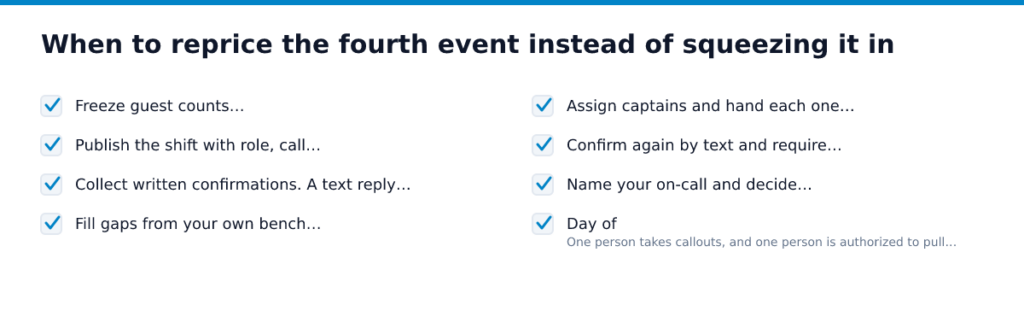
- Freeze guest counts against the contract’s final-count deadline and get the number in writing from the client. Crew size is downstream of that number, so nothing below this step is real until it lands.
- Publish the shift with role, call time, venue, uniform, and end time. A posting that says “Saturday, PM, banquet” produces a commitment just as vague.
- Collect written confirmations. A text reply counts; a nod in the hallway does not.
- Fill gaps from your own bench first, then agency staff, and write down the agency’s markup and its minimum-hours clause before you book anyone.
- Assign captains and hand each one the run sheet in writing, not a verbal briefing at load-in.
- Confirm again by text and require a reply. Count every non-reply as an open shift, not a probable yes.
- Name your on-call and decide whether they get a call-in minimum, then tell them the number.
- Day of: One person takes callouts, and one person is authorized to pull float staff between events. Same person is fine; two people improvising is not.
Automate the confirm-and-reply loop so your open-shift count is a live number rather than something a manager reconstructs from memory on Friday night. How to Manage Staff Scheduling with Catering Software covers the setup, and How Online Catering Scheduling Works (2026 Guide for Catering Businesses) explains how event bookings feed it. Overtime is computed workweek by workweek, and a heavy Saturday can’t be averaged against a slow following week (29 CFR 778.104 — Each workweek stands alone.).
When to reprice the fourth event instead of squeezing it in
Once the confirmed Saturday crew hits its ceiling, a fourth inquiry gets one of three answers. Quote it at a Saturday premium that actually funds the overload. Move it to Friday or Sunday, where your bench is rested and straight-time. Or hand it to a peer whose calendar is open and who will send one back to you in March.
Price the premium against what the fourth event really costs you: overtime hours at time-and-one-half for every non-exempt hour past 40 that week (Fact Sheet #23), the agency markup on borrowed servers, a second vehicle and its driver, and the captain you no longer have on site because she’s running event two.
Then protect the locked crew with dates. Final counts and cancellation windows belong in the contract, as covered in Catering Deposits and Cancellations: Contract Terms That Hold Up Against Chargebacks. We’d rather lose one booking than staff three events thin and refund all of them.
Frequently Asked Questions
What is the best staff scheduling method for a small catering team?
Build a standing tier list of your crew, ranked by which roles each person can actually work, then fill Saturday from the top of that list before you touch anyone else. A team of fifteen usually breaks into four or five leads who can run a room alone, a middle tier of servers who can also set and strike, and a bottom tier you call for load-in and dish only. Set your workweek so it starts on a day that puts Saturday early in it, since each workweek stands alone for overtime purposes and hours can’t be averaged across two of them (29 CFR 778.104 — Each workweek stands alone.). That one choice decides whether a Friday setup and a Saturday service land in the same overtime bucket.