By cloudcateringmanager January 20, 2026
Recurring billing for corporate catering accounts is one of the fastest ways to turn “busy seasons” into predictable, year-round revenue. Instead of chasing one-off event payments and dealing with last-minute invoice questions, you set clear billing rules, automate collection, and give corporate clients a clean, finance-friendly process that fits how they already buy.
Done right, recurring billing for corporate catering accounts also reduces admin time, lowers payment friction, and builds stickier client relationships—because corporate customers value reliability as much as food quality.
Corporate catering often lives in the middle ground between services and events. A single client might order weekly lunches, monthly meetings, quarterly town halls, and occasional executive receptions.
Without a repeatable billing structure, your team ends up rebuilding quotes, invoices, and payment follow-ups from scratch. That’s where recurring billing for corporate catering accounts becomes more than a billing method—it becomes an operating system.
You define the service cadence, the pricing logic, the approval workflow, and the payment rails once, then let automation do the heavy lifting.
This guide breaks down recurring billing for corporate catering accounts from the ground up: how to structure contracts, select payment methods, design billing cadences, reduce disputes, and align invoicing with corporate finance requirements.
You’ll also learn implementation steps, best practices for renewals and expansions, and future predictions as faster payments and tighter security standards shape how businesses pay.
Why Recurring Billing for Corporate Catering Accounts Works So Well
Recurring billing for corporate catering accounts works because it matches corporate behavior: companies want predictable costs, simple approvals, and standardized vendors. When corporate clients find a caterer that delivers consistently, they prefer not to re-shop every week.
They want a repeatable process with minimal surprises—especially when orders are placed by admins, office managers, or facilities teams but reviewed by finance later.
From your side, recurring billing for corporate catering accounts eliminates the most common cash-flow headaches in catering: late invoice approvals, missing purchase orders, inconsistent billing contacts, and unclear responsibility when an event changes.
When you set recurring billing rules upfront, you reduce back-and-forth. Your team spends less time chasing signatures and more time improving execution and service.
Recurring billing for corporate catering accounts also creates cleaner forecasting. Instead of guessing revenue based on event pipelines, you can estimate baseline monthly revenue from active accounts.
That improves hiring decisions, ingredient purchasing, and delivery scheduling. It also helps you set smarter minimums, delivery zones, and production capacity, because recurring volume is more predictable than ad hoc events.
Finally, recurring billing for corporate catering accounts supports better client experience. Corporate customers don’t want “payment drama.” They want invoices that match their internal coding, billing dates that align with their periods, and payment methods that meet their controls.
A well-built recurring billing program gives them that consistency—so renewing and expanding the account becomes the default.
Designing a Corporate Catering Account Model That Supports Recurring Billing
Recurring billing for corporate catering accounts is easiest when you define what “an account” really means in your business. A corporate account is not just a customer name—it’s a structured relationship with a set of billing rules, ordering rules, and approval rules.
Before you talk about payment methods, you need an operating model that’s simple enough to run and robust enough to handle changes.
Start by categorizing corporate catering accounts into tiers. For example: (1) routine meal programs (weekly lunches, shift meals), (2) meeting catering (variable headcounts but repeat meetings), and (3) event catering (larger, scheduled events that may still repeat quarterly).
Each tier should map to a billing cadence and pricing approach. This is how recurring billing for corporate catering accounts stays consistent even when orders differ.
Next, standardize your account profile fields. At minimum, capture: billing entity name, billing address, accounts payable email, invoice submission portal (if any), preferred invoice format (PDF, EDI, portal upload), payment method preferences, purchase order requirements, tax exemption certificates (when applicable), cost center codes, and an internal approver contact. Recurring billing for corporate catering accounts fails when these details are scattered across emails.
Then, define ordering channels. Decide whether orders must come through a portal, email template, or a dedicated account manager. The more standardized ordering becomes, the smoother recurring billing for corporate catering accounts will run—because invoice lines can be generated from consistent order data rather than human interpretation.
Structuring Contracts for Recurring Billing for Corporate Catering Accounts
Recurring billing for corporate catering accounts becomes dramatically easier when your contract does the “explaining” before problems occur.
The contract should translate catering reality—headcount changes, delivery issues, add-ons, dietary substitutions—into billing rules that corporate finance teams can accept. If you only “quote menus,” you’ll keep renegotiating invoices later.
At a minimum, your recurring billing agreement should define: service scope (what types of catering are included), service days and cutoffs, pricing logic (per-person, per-order, per-package), minimum order requirements, delivery fees, service fees, change/cancellation windows, dispute timelines, and payment terms.
It should also define the billing cadence: weekly, biweekly, monthly, or hybrid. Recurring billing for corporate catering accounts works best when the contract matches how the client budgets.
Include a billing contacts clause. Corporate clients change staff frequently, and invoices get delayed when your billing email goes stale. Your contract should require the client to update billing contacts within a set period and clarify that missed updates do not pause recurring billing for corporate catering accounts.
Finally, address renewals and price adjustments. If you don’t define how pricing changes, you risk either eroding margins or triggering disputes. A smart approach is a defined annual review window with notice periods, tied to cost changes. Corporate clients often accept predictable adjustments when they’re communicated clearly and contractually.
Pricing Structures That Make Recurring Billing Stable
Recurring billing for corporate catering accounts depends heavily on pricing design. The goal is to keep invoices predictable without undercharging for variability. The strongest pricing structures are usually “modular”: a base recurring package plus clearly-priced add-ons.
A common model is a monthly base fee that covers a defined number of service days or meal drops, plus per-head pricing for actual attendance.
Another model is a flat recurring amount for a standard menu rotation (for example, weekly lunches for up to a certain headcount), with overage charges when headcount exceeds the cap. This is especially effective when the client wants fixed budgeting and you want protection from sudden volume spikes.
You can also use a unit-based menu system (Tier A/B/C) where each item maps to a unit cost. The account is billed on a recurring cadence, but each invoice includes unit totals. This makes recurring billing for corporate catering accounts easier to approve because finance can audit line items while still paying on a predictable schedule.
Avoid “custom-only” pricing for recurring accounts unless your margins can handle it. Custom menus create invoice complexity, and complexity is the enemy of recurring billing for corporate catering accounts. Save customization for defined event add-ons with separate approval steps.
Policies for Changes, Cancellations, and On-Site Surprises
Recurring billing for corporate catering accounts must assume reality: meetings run long, headcounts change, and someone will request “just one more tray” onsite. If your contract doesn’t address changes, your team will either eat the cost or fight over it later.
Set clear cutoffs for changes. For routine meal programs, a same-day cutoff might be unrealistic; instead, set day-before cutoffs with a smaller “adjustment window” for minor shifts. Define cancellation fees in a way that corporate clients can justify internally: tie fees to incurred costs (labor, ingredients, reserved capacity) rather than vague penalties.
On-site add-ons should have a pre-approved mechanism. For example, you can authorize the onsite contact to approve add-ons up to a limit per occurrence, with signed delivery confirmation or digital approval. That protects recurring billing for corporate catering accounts from becoming a dispute magnet.
Finally, define how delivery issues are handled. Corporate clients appreciate fairness: if you’re late beyond a threshold, you credit a portion; if the client provided wrong details, billing remains. Clear rules reduce emotional escalation and keep recurring billing for corporate catering accounts stable.
Payment Methods and Rails for Recurring Billing for Corporate Catering Accounts
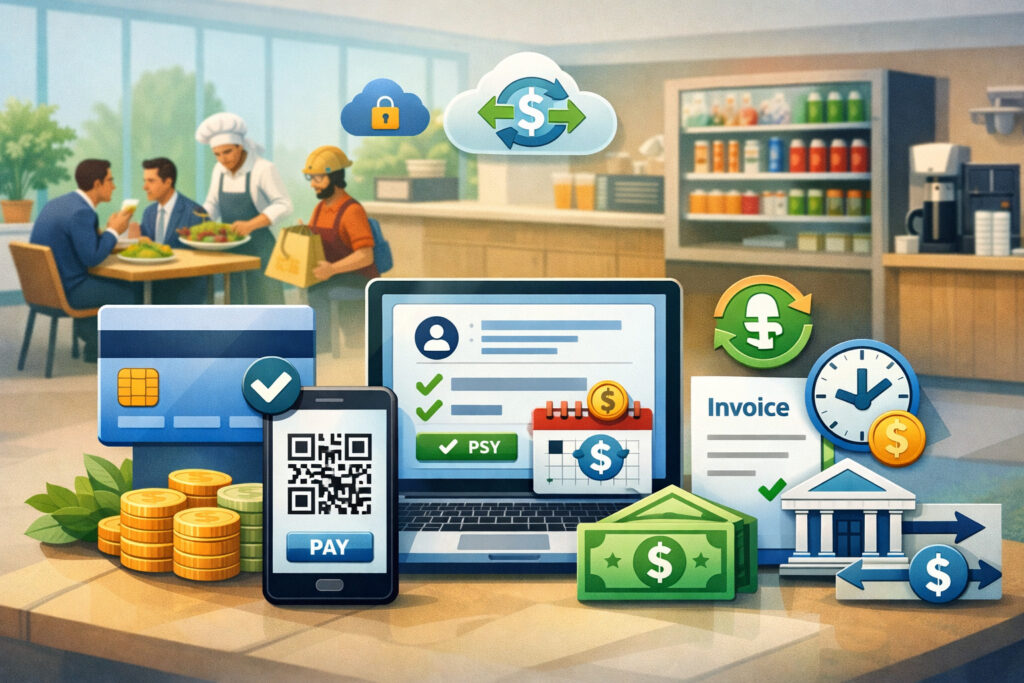
Recurring billing for corporate catering accounts is not “one payment method.” Corporate buyers often have preferences based on controls, fees, and audit requirements. Your strategy should support at least three rails: card payments (including virtual cards), bank payments (ACH), and faster payments where available.
Card-based recurring billing is convenient, but fees can be higher. It’s common for corporate clients to use virtual cards for vendor payments because they can set limits and control spending by transaction.
For recurring billing for corporate catering accounts, that might mean the client generates a new virtual card number monthly or per invoice. If you can support that workflow, approvals can be faster.
ACH is often the best long-term option for recurring billing for corporate catering accounts because it’s cost-effective and fits corporate finance workflows.
However, ACH requires strong verification, clear authorization language, and careful handling of returns and disputes. Nacha’s rules evolve over time, and recent updates have emphasized fraud detection and risk management across ACH participants.
Faster payments are becoming more relevant for business-to-business use, especially for last-minute changes or urgent balances. The Federal Reserve’s instant payments service has highlighted ongoing adoption and added features like request-for-payment capability and fraud tools.
The Clearing House has also reported rapid growth in RTP network value and usage, signaling broader business adoption for higher-value instant payments.
The “best” rail depends on the client. The best approach is to offer options while guiding accounts into the rail that balances cost, speed, and approval simplicity.
Using ACH Safely in Recurring Billing for Corporate Catering Accounts
Recurring billing for corporate catering accounts using ACH can be highly profitable because it reduces processing costs and supports predictable settlement. But ACH introduces operational risks if you don’t set it up correctly.
Start with proper authorization. Your recurring billing authorization should cover the cadence, the amount logic (fixed, variable, or capped), and how notice is provided. If you bill variable amounts, define how you’ll deliver invoice notices before the debit date. This reduces disputes and helps the client’s finance team reconcile debits.
Next, verify bank details using a robust process. Avoid relying on emailed account numbers. Use secure forms, bank verification tools, or validated onboarding workflows.
Then, build a return management policy: what happens if an ACH debit returns due to insufficient funds, closed account, or unauthorized claims? Recurring billing for corporate catering accounts needs a consistent rule, like switching to card until ACH is re-verified.
Also, align with risk management expectations. Industry guidance has emphasized increased focus on fraud detection and risk controls in ACH operations.
Even if you’re not a bank, your processors and partners may enforce stricter underwriting or monitoring. Plan for it by keeping clean documentation: signed authorization, delivery confirmations, and invoice notices.
When Instant Payments Make Sense for Corporate Catering
Recurring billing for corporate catering accounts doesn’t always need instant payments—but instant payments can solve specific problems: urgent event balances, deposit releases, last-minute add-ons, or “save-the-account” situations where payment delays disrupt service.
Instant payments are built for 24/7 availability, which can help when corporate events happen outside normal banking hours.
The Federal Reserve describes features like request-for-payment and fraud tools that are designed to support safer instant payment operations over time. Meanwhile, reported growth in RTP value suggests businesses are increasingly comfortable pushing larger payments instantly.
A practical approach is to keep recurring billing for corporate catering accounts on ACH or card for baseline invoices, but enable instant payment links for special cases: rush orders, settlement of aged invoices, or replacing a declined card quickly.
You can also use instant payments as a retention tool: if a client’s AP backlog is delaying you, an instant payment option can keep service running while they clean up internal approvals.
Building the Right Billing Cadence for Corporate Catering Accounts
Recurring billing for corporate catering accounts is not just “monthly.” The cadence must match ordering behavior, approval cycles, and your operational reality. The wrong cadence creates disputes, late payments, or unnecessary admin work.
Weekly billing works best when your client orders frequently and wants tight budget control—like daily lunches or multiple weekly drops. Weekly invoices reduce “sticker shock” and make it easier for the client to match invoices to events. However, weekly billing can create more invoice volume, so it must be automated.
Monthly billing is common for larger corporate catering accounts because it aligns with accounting periods. It also reduces invoice count and can feel more “enterprise-friendly.” The risk is that month-end invoices become large and attract more scrutiny.
Recurring billing for corporate catering accounts on a monthly schedule should include clean categorization and detailed line-item structure.
Hybrid billing is often the best fit: routine meals billed on a recurring monthly base, and larger events billed separately on delivery or milestone terms. This keeps recurring billing for corporate catering accounts predictable while preserving control over high-variance events.
Your cadence should also define deposit logic. For event-heavy accounts, require deposits for large events even if the account has monthly recurring billing. Deposits reduce your exposure if an event is canceled late or the client’s AP process delays payment.
Cutoffs, Service Periods, and “Billing Clarity”
Recurring billing for corporate catering accounts succeeds when the client can clearly see what they’re paying for. That means defining service periods. For example: “Invoices cover services delivered from the 1st through the last day of the month,” or “Invoices cover Monday through Sunday deliveries.”
Set cutoffs for invoice generation and approvals. If you generate invoices at midnight on the last day, your operations team may still be adjusting orders.
Instead, choose a clean cutoff and define how late adjustments are handled (for example, posted to the next invoice as credits/charges). Corporate finance teams prefer consistent rules over perfect precision.
Also build a “billing clarity layer”: a short invoice summary that lists service period, total events/orders, any credits, and any overages. This small addition reduces AP questions dramatically and makes recurring billing for corporate catering accounts feel professional and reliable.
Invoicing That Corporate Finance Teams Approve Faster
Recurring billing for corporate catering accounts often fails at the invoice—not because the service was wrong, but because the invoice doesn’t fit corporate approval systems. Your invoice must be easy to audit. If AP can’t match it to a PO, cost center, or internal event record, it will sit.
Start with consistent invoice formatting: same header layout, same naming conventions, and predictable line categories. Include order references (meeting name, department, internal event ID) whenever possible. If the client uses purchase orders, show the PO number prominently and ensure it matches exactly.
Corporate clients also care about descriptions. “Catering services” is too vague. Use structured descriptions: “Lunch catering – 42 attendees – Department meeting – delivery fee – service fee.” This is not just “nice”—it’s what reduces disputes and accelerates approvals.
Many invoicing guides for catering emphasize clarity, standardized details, and predictable structure because it speeds payment and reduces confusion. That becomes even more important with recurring billing for corporate catering accounts, where small recurring errors compound over time.
Finally, include payment instructions clearly and consistently. If you accept ACH, include bank payment instructions or a secure payment link. If you accept cards, provide a secure portal rather than collecting card details via email.
Managing Risk, Chargebacks, and Security in Recurring Billing
Recurring billing for corporate catering accounts must be designed to reduce disputes, protect stored payment credentials, and align with security standards. Even if most corporate clients pay reliably, a single disputed charge or data-handling issue can create major operational and reputation risk.
If you store card details, do it the right way. Use tokenization through your payment provider so sensitive data is not stored in your systems. Implement role-based access so only authorized staff can manage billing profiles. Document billing approvals and delivery confirmations, because evidence is what wins disputes.
Security standards also evolve. The PCI Security Standards Council has documented timelines and transition periods related to PCI DSS v4.0 and future-dated requirements.
For recurring billing for corporate catering accounts, the practical takeaway is simple: assume controls will tighten over time. Build your billing program on secure payment pages, tokenization, logging, and limited access now—so you’re not scrambling later.
Also define a dispute policy. Corporate disputes often aren’t “fraud”—they’re mismatches: wrong department code, missing PO, or headcount disagreements.
Your process should include: (1) a dispute window, (2) a required dispute format (what info they must provide), (3) a clear resolution timeline, and (4) how credits are applied. Recurring billing for corporate catering accounts becomes much calmer when disputes are treated as a workflow rather than a fight.
Automating Recurring Billing Without Losing Control
Recurring billing for corporate catering accounts should be automated, but not “hands-off.” The goal is controlled automation: your system generates invoices and collects payments predictably, while your team monitors exceptions.
Start with system integration. At minimum, your ordering system (or POS), your CRM/account notes, and your accounting platform should share consistent identifiers: customer account ID, invoice ID, and service period. When recurring billing for corporate catering accounts is disconnected, staff end up retyping data, and retyping creates errors.
Next, automate invoice creation rules. Examples:
- Create a monthly invoice on the 1st for the prior period.
- Add delivery confirmations as attachments automatically.
- Apply contracted pricing logic with caps and overage rules.
- Apply tax rules consistently and attach exemption certificates if relevant.
Then, automate payment reminders for invoice-based accounts. Corporate clients often pay on terms, so you don’t want to “spam,” but you do want predictable nudges: invoice sent, reminder at X days, reminder at Y days, escalation to account manager.
Finally, build exception dashboards. Monitor failed payments, missing POs, disputes opened, credit volume, and overdue invoices. Automation makes recurring billing for corporate catering accounts scalable—but monitoring makes it safe.
Account Growth: Upsells, Renewals, and Retention Through Recurring Billing
Recurring billing for corporate catering accounts is not only about getting paid—it’s also a growth engine. Once billing is predictable, your conversations shift from “where’s the invoice?” to “how do we expand service?”
Use renewal cycles to re-anchor values. A simple quarterly business review (QBR) can increase retention: show reliability metrics, on-time delivery rate, menu satisfaction feedback, and billing accuracy. Corporate clients renew vendors that remove friction.
Upsells work best when they match existing billing logic. For example, add a “monthly breakfast add-on” or “quarterly executive reception package” that simply extends recurring billing for corporate catering accounts rather than creating one-off complexity. Keep add-ons packaged and priced. If every add-on is custom, your billing becomes fragile again.
Also consider multi-location expansions. Many corporate catering accounts start at one office. If you can replicate the billing model across locations—same invoice structure, same cadence, location-based line items—you become the default vendor, not just “a vendor.”
Key Metrics to Track for Recurring Billing for Corporate Catering Accounts
Recurring billing for corporate catering accounts should be managed with metrics that reflect both finance health and service health. When you measure the right things, you find issues early and improve profitability without guessing.
Track these core metrics:
- Invoice aging by account tier: Identify where approvals stall.
- Dispute rate: Count disputes per invoice and disputes per dollar.
- Payment failure rate (for auto-pay): Monitor declines, returns, and expired virtual cards.
- Credit volume: Too many credits often indicate operational or contract clarity issues.
- Gross margin by account: Recurring revenue is great, but not if margins erode.
- Revenue predictability: Compare forecasted recurring billing to actual collected revenue.
- Expansion rate: Measure account growth month over month.
Recurring billing for corporate catering accounts also benefits from operational metrics tied to billing outcomes: late delivery incidents, missing items, last-minute headcount changes, and “unplanned add-ons.”
These are leading indicators of disputes. When you connect service metrics to billing metrics, you can prevent problems rather than just responding to them.
30–60–90 Day Implementation Plan for Recurring Billing
Recurring billing for corporate catering accounts is easiest to implement in phases. If you try to switch every account at once, you’ll create confusion. A 30–60–90 plan keeps it clean.
Days 1–30: Foundation
Define your account tiers, billing cadences, contract templates, and invoice templates. Build a standard onboarding checklist for corporate catering accounts: billing contacts, PO rules, tax documents, and payment method setup.
Choose a secure payment workflow and ensure staff know the rules for collecting billing info. This is also when you decide which accounts move to recurring billing for corporate catering accounts first (typically your most consistent customers).
Days 31–60: Pilot
Move a small set of accounts into recurring billing. Track invoice approval time and dispute reasons. Adjust templates, cutoffs, and pricing logic based on real feedback. Train account managers to sell the benefits: predictable budgeting and fewer admin steps. Refine internal roles so operations, billing, and sales aren’t stepping on each other.
Days 61–90: Scale
Roll recurring billing for corporate catering accounts to the rest of your target base. Add automation rules, reminders, and exception dashboards. Formalize renewals and introduce expansion offers. At this stage, you should also document your dispute process and create a “billing guide” you can send to new clients.
Future Predictions: Where Recurring Billing in Corporate Catering Is Headed
Recurring billing for corporate catering accounts is likely to become more automated, more controlled, and more connected to faster payment systems. Corporate finance teams want better auditability, and vendors want faster settlement with fewer fees. Those pressures tend to push the market toward structured recurring billing plus improved payment rails.
First, expect faster payments to play a bigger role in exceptions and urgent settlements. The Federal Reserve continues to describe ongoing development and adoption of its instant payments service, including capabilities like request-for-payment that can streamline how businesses ask for money.
At the same time, growth in the RTP network suggests increasing comfort with higher-value instant transactions. Over the next few years, it’s reasonable to expect corporate catering vendors to use instant payment requests for deposits, rush orders, and overdue balances—while keeping routine recurring billing on traditional rails.
Second, security expectations will keep rising. PCI DSS v4.0 timelines and future-dated requirements signal continued tightening of controls around payment data handling.
For recurring billing for corporate catering accounts, that means more reliance on tokenization, reduced manual handling of payment credentials, stronger access controls, and better logging.
Third, corporate procurement will continue pushing vendors toward standardized invoicing. Many companies are centralizing AP workflows, which means recurring billing for corporate catering accounts will increasingly need consistent invoice data, clear service periods, and integration-friendly formats. Vendors who can deliver “invoice perfection” will win larger, longer contracts.
FAQs
Q.1: What’s the easiest way to introduce recurring billing to an existing corporate client?
Answer: The easiest way to introduce recurring billing for corporate catering accounts is to frame it as an upgrade in convenience and control—not a change that benefits only you.
Start by explaining that recurring billing reduces invoice volume confusion, standardizes service periods, and makes budgeting easier. Offer two or three cadence options (weekly, monthly, hybrid) and recommend the one that matches their ordering frequency.
Then, present a simple transition: keep current pricing, but move to a structured invoice schedule with clearer line items and a dedicated billing contact path.
If the client is nervous, pilot recurring billing for corporate catering accounts for 30 days and agree to review. Most clients accept the change when they see fewer billing emails and faster approvals.
Q.2: Should recurring billing be fixed-price or variable?
Answer: Recurring billing for corporate catering accounts can be fixed, variable, or hybrid. Fixed-price works when the service is consistent (like a defined weekly lunch package). Variable works when headcounts fluctuate and the client wants to pay “as used.”
Hybrid is often best: a base recurring amount plus overage rules. The best choice depends on how much variability you can operationally absorb and how much budgeting predictability the client needs. The key is to define the pricing logic clearly in the contract so invoices don’t feel surprising.
Q.3: How do you handle purchase orders with recurring billing?
Answer: Recurring billing for corporate catering accounts can work with purchase orders if you design the workflow upfront. Some companies issue blanket POs for a quarter or year, while others require a PO per event. Your onboarding should identify which model they use and how they want PO numbers displayed on invoices.
If they require POs frequently, consider building an ordering template that requires a PO field before confirmation. That prevents “service delivered but invoice rejected” scenarios.
If they use blanket POs, make sure the PO number is consistent across invoices and that invoices show the service period clearly so AP can match it quickly.
Q.4: What if a corporate client wants to pay by virtual card?
Answer: Virtual cards are common in recurring billing for corporate catering accounts because they allow corporate controls and spending limits.
The workflow usually means the client provides a new card number periodically (monthly or per invoice). Your job is to make it easy: send secure payment links, allow self-service updates, and ensure receipts are automated.
To reduce failures, set reminders before the billing date so the client can refresh the virtual card. Also, define what happens if payment fails—such as switching to ACH temporarily or pausing non-critical service until payment is updated. Clear rules keep the relationship professional.
Q.5: How can you reduce disputes in recurring billing?
Answer: To reduce disputes in recurring billing for corporate catering accounts, focus on three areas: clarity, evidence, and speed. Clarity means invoices show service period, event references, headcounts, and pricing logic.
Evidence means you keep delivery confirmations, approved change requests, and written policies for changes/cancellations. Speed means you respond to disputes quickly with a structured workflow so issues don’t linger across billing cycles.
The more repeatable your dispute process becomes, the less emotional it feels. Over time, recurring billing for corporate catering accounts becomes smoother because both sides know exactly how issues will be handled.
Conclusion
Recurring billing for corporate catering accounts is one of the most practical ways to build stable revenue in a business that’s often treated like “event-by-event” work. When you standardize contracts, align invoices to corporate finance expectations, choose the right payment rails, and automate with control, you turn corporate catering into a predictable engine—without sacrificing flexibility for real-world changes.
The best recurring billing for corporate catering accounts is simple for the client and disciplined for you. It reduces billing friction, improves cash flow, and makes your service easier to expand across departments and locations.
As faster payment options grow and security standards tighten, vendors with clean recurring billing systems will be the ones that win long-term corporate relationships—and keep them.