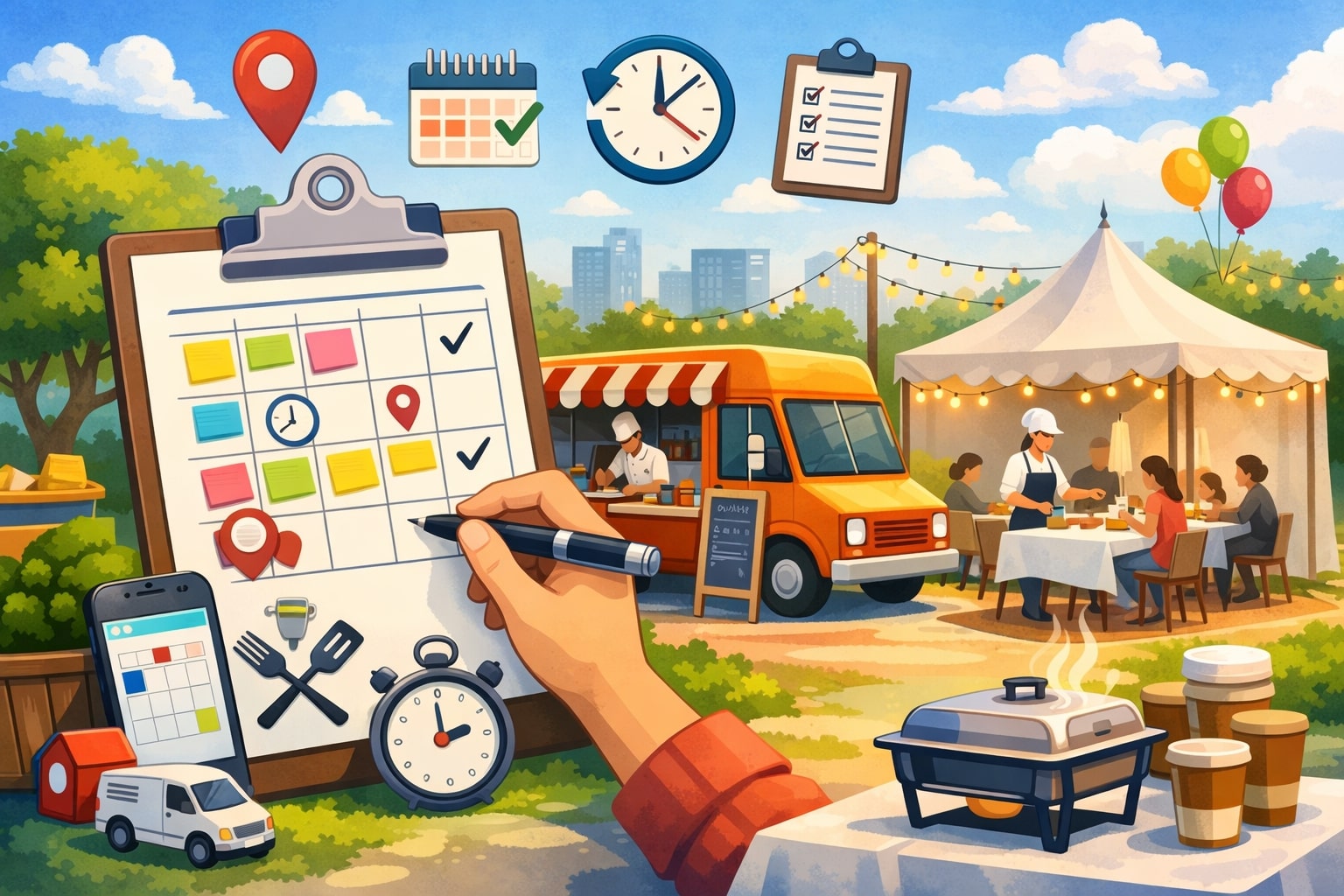
Pop-ups and temporary events look simple from the outside: show up, serve great food, pack up, repeat. In reality, they are one of the most scheduling-intensive formats in modern food service.
The window to produce, transport, set up, and serve is tighter than traditional catering. The margin for error is smaller because you often have limited staff, limited storage, limited utilities, and unpredictable foot traffic.
That’s why catering scheduling becomes the difference between a smooth, profitable event and a chaotic one that burns time, inventory, and reputation. Unlike fixed venues, pop-ups may rely on borrowed kitchens, shared loading docks, temporary permits, and rotating vendor requirements. A good plan has to work even when the plan changes.
This guide is built for real-world execution. You’ll learn how to design a scheduling system that accounts for menu complexity, production lead times, staffing coverage, travel, equipment, and compliance—without turning the process into paperwork overload.
You’ll also see how catering scheduling for pop-ups and temporary events is evolving, and how to build a future-proof process that scales across multiple locations and event partners.
Understanding the Pop-Up and Temporary Event Scheduling Reality

Pop-ups compress the catering lifecycle. In a typical catering job, you may have a stable venue, a known headcount, predictable utilities, and plenty of time for setup.
Temporary events flip that. You might be serving in a parking lot, inside a retail store, at a community festival, or at a private brand activation with strict time blocks. The schedule is not just “what time do we serve,” but a chain of dependencies that starts days earlier and ends hours after service.
Strong catering scheduling starts by understanding the forces that make pop-ups different: uncertain demand, limited infrastructure, and high coordination costs. You are often building a “mini restaurant” from scratch, then tearing it down quickly.
That means scheduling must include procurement windows, batch cooking cycles, equipment staging, transportation buffers, and teardown labor—not just staffing during service.
Most pop-up failures are not food-quality failures. They are schedule failures. The team runs out of time for prep. Setup overlaps with a venue restriction. A delivery arrives late and pushes production.
The line gets too long because service pacing wasn’t planned. When you treat scheduling as an operational design problem, you gain control. When you treat it as a calendar problem, you lose money.
Finally, pop-ups reward repeatability. If you can standardize your catering scheduling system across different temporary events, you can scale faster, train staff better, and reduce last-minute decision-making.
Your goal is to build a scheduling “engine” that produces consistent outcomes in inconsistent environments.
Event Types and Service Models That Change Scheduling
Pop-ups can look similar on social media, but the schedule requirements vary drastically by event type and service style. A corporate brand activation with pre-registered guests has predictable flow and tighter brand rules.
A street festival has high variability and weather risk. A private ticketed dinner has a fixed headcount but more complex timing around courses and guest experience.
Your catering scheduling must start by classifying the service model. Are you doing grab-and-go, buffet, plated, passed bites, food truck-style service, or pre-orders with pickup windows?
Each model changes staffing ratios, prep cycles, holding strategy, and packaging needs. Grab-and-go may demand more packaging and staging. Plated service demands synchronized cooking and runners. Pre-order pickup demands accurate time slots and staging zones.
Temporary events also shift responsibilities. Sometimes you control the full guest experience. Sometimes you are one vendor among many and must align with an organizer’s load-in schedule.
Some venues provide tables and power, while others provide nothing. If you don’t schedule around these constraints, you’ll spend event day “buying time” with stress and shortcuts.
The practical move is to attach a scheduling “profile” to each event type. The profile sets default lead times, staffing coverage, setup duration, teardown duration, and contingency buffers. Over time, your catering scheduling becomes faster because you’re not reinventing the plan for every pop-up.
Aligning Stakeholders and Dependencies Early
Pop-ups bring more stakeholders into your timeline. You may coordinate with event organizers, venue managers, brand teams, security, other vendors, rental companies, and inspectors. If their timelines aren’t aligned, your execution will suffer even if your internal plan is perfect.
A reliable catering scheduling process includes an early dependency check. Confirm load-in windows, parking rules, elevator access, power availability, water access, waste disposal, and storage limitations.
Confirm whether you can use open flames, propane, or generators. Confirm how early you can start setup and how late you can stay for teardown. These are scheduling constraints, not “details.”
Also define decision deadlines. When is the final headcount? When is the menu locked? When are dietary restrictions due? When must the venue receive certificates of insurance? Scheduling improves when deadlines are explicit, because production and purchasing depend on them.
One of the best tricks in catering scheduling for pop-ups and temporary events is to make a single-page “event brief” that captures all stakeholder commitments and hard constraints. When the team has one source of truth, you reduce last-minute confusion and avoid time-wasting calls on event day.
Building a Repeatable Catering Scheduling Framework
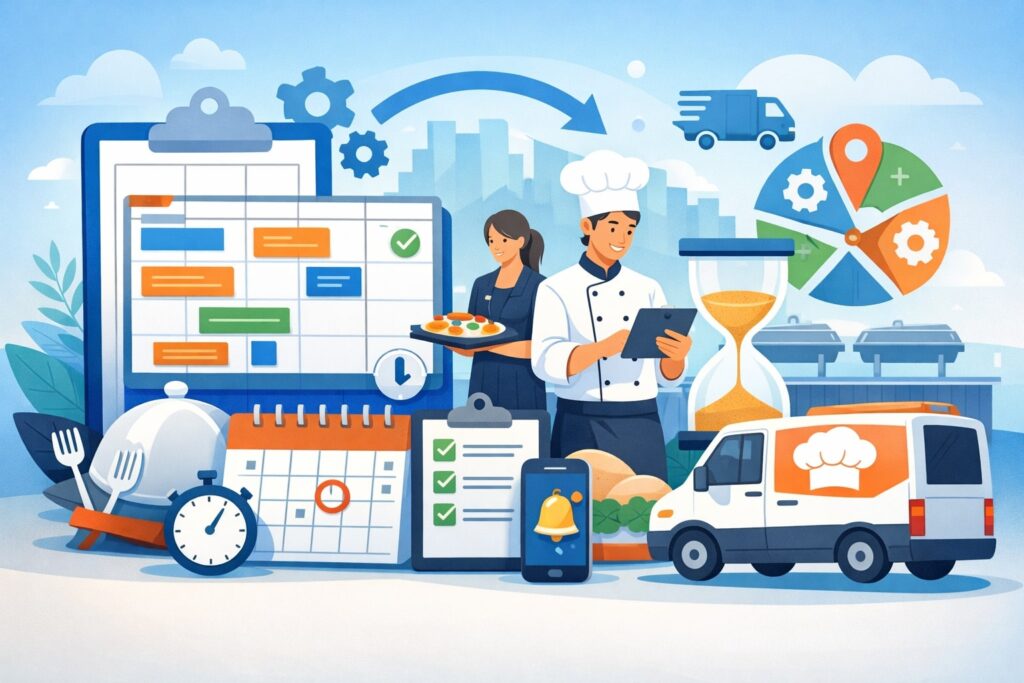
A framework is what turns stressful one-off pop-ups into a scalable revenue channel. The goal is not to predict everything. The goal is to create a schedule structure that can absorb change without breaking. That means defining phases, assigning owners, and building buffers in the right places.
Start with phases that match how catering actually happens: discovery and confirmation, purchasing, production, packing, transport, setup, service, teardown, and reconciliation. Your catering scheduling should tie each phase to a checklist and a time window. If something changes, you can see what downstream steps are impacted.
Next, choose the scheduling “unit” you’ll manage. For temporary events, you should schedule by task blocks, not just shifts.
Example: “Prep proteins 8:00–10:30,” “Pack hot holding 10:30–11:15,” “Load vehicle 11:15–11:45,” and so on. Task-based catering scheduling makes your plan executable, not just readable.
Finally, create templates. Pop-ups are repetitive in the best way: load-in, setup, service, teardown. Templates allow you to start at 70% complete and customize the rest. Over time, your catering scheduling becomes a competitive advantage because you can commit faster, price smarter, and deliver more consistently.
Backward Planning From Service Time
Backward planning is the core technique for pop-up success. You begin with the service start time and build the schedule in reverse, identifying the latest safe time to complete each dependency. This is essential because pop-ups don’t forgive late setup or delayed hot food.
In catering scheduling, backward planning should include “hard stops” and “soft buffers.” A hard stop might be a venue rule: load-in ends at 3:00 PM.
A soft buffer might be your travel cushion: add 20–45 minutes depending on distance, parking complexity, and elevator access. You’ll also add buffers for cooking and holding based on food safety and quality.
A helpful approach is to define your “critical path,” the longest chain of dependent tasks that cannot slip.
For example: vendor pickup → kitchen prep → cooking → hot holding → transport → setup → service. If any step slips, the event slips. That critical path deserves the most attention and the biggest buffers in your catering scheduling.
Backward planning also clarifies staffing. If packing and loading overlap, you may need extra hands earlier even if service seems “light.” When you schedule from the end backward, staffing becomes more accurate, and the team feels less rushed.
Matching Menu Complexity to Time and Capacity
Pop-up menus should be designed for production flow, not just creativity. If the menu is too complex for the available prep time, you’ll either miss the schedule or compromise quality. Effective catering scheduling connects menu decisions to labor minutes, equipment capacity, and holding limitations.
Start by categorizing menu items by production intensity: high-touch (multiple components, finishing steps), moderate-touch, and low-touch (batchable, stable, easy to portion). For pop-ups, you want a menu mix that includes enough low- and moderate-touch items to protect your schedule when demand spikes.
Next, map production to equipment. How many burners, ovens, hot boxes, coolers, and prep tables do you actually have? Temporary events often restrict equipment use, so your kitchen plan might be different from your service plan.
Strong catering scheduling for pop-ups and temporary events includes a capacity check: “Can we cook, hold, and serve this menu with the tools available?”
Lastly, schedule portioning and packaging. Pop-ups often require individual packaging, labels, allergens, and branded presentation. That’s labor. If you don’t schedule it, it will steal time from setup and service. When menu complexity is matched to schedule reality, you get faster lines, better consistency, and higher profits.
Staffing, Labor Planning, and Compliance for Temporary Events
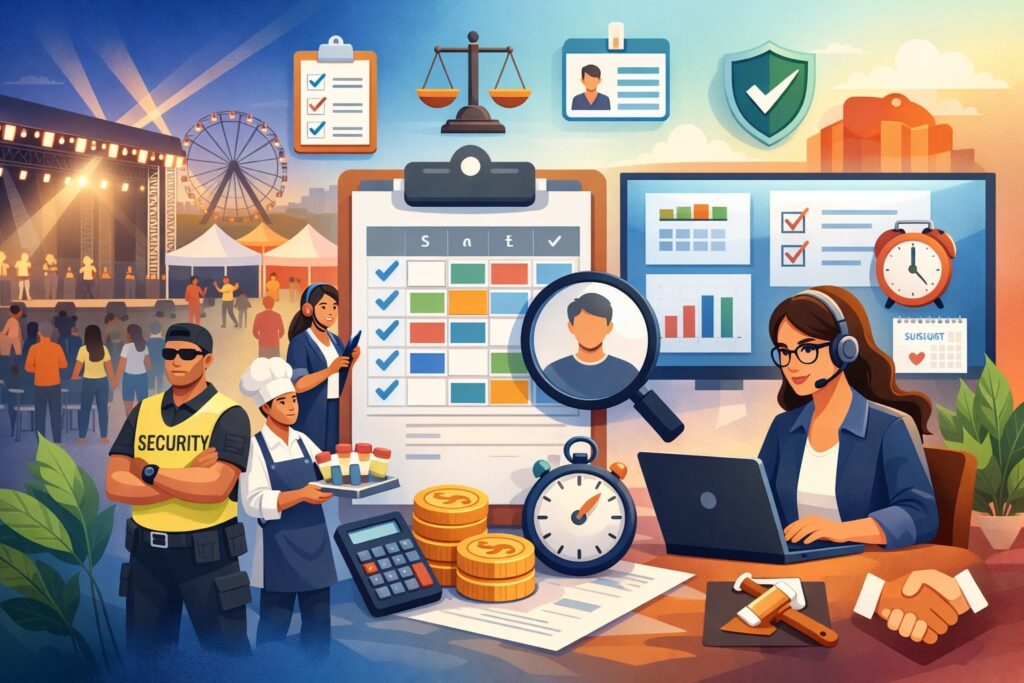
Pop-ups require flexible staffing. You need people who can prep, pack, set up, serve, reset, and tear down—often in one shift. A scheduling mistake can show up as slow service, safety issues, or burnout. Good catering scheduling is as much about people’s design as it is about time blocks.
Start with role clarity. Even if you have a small crew, define who owns each zone: kitchen lead, expo/runner, cashier/POS, line server, floater, and teardown lead. In temporary settings, “everyone helps” is not a role. It’s a recipe for tasks falling through the cracks.
Next, account for stamina and peak workload. Pop-up shifts can include early prep, heavy lifting, long standing hours, and high guest interaction. Your catering scheduling should include short recovery windows, hydration time, and clear handoffs. This is not just kindness; it’s operational reliability.
Compliance matters too. Labor rules vary by state and city, and requirements for breaks, overtime, and youth workers can change scheduling decisions. You don’t need to become a lawyer, but you do need a system that flags risk. A disciplined scheduling process reduces payroll surprises and lowers turnover.
Role Design, Cross-Training, and Coverage Ratios
Pop-up staffing works best when roles are simple and cross-training is intentional. Instead of hiring a unique person for every micro-task, you build a crew that can rotate between stations without losing quality. That keeps labor efficient and protects you when someone calls out.
In catering scheduling, define “core” roles (must be staffed continuously) and “flex” roles (can shift based on demand). Core roles often include line service, POS, and a lead who monitors quality and timing. Flex roles may include a floater who restocks, runs trash, resets serviceware, and supports setup or teardown.
Coverage ratios depend on the service model. A high-volume grab-and-go pop-up may need more people on packaging and restocking. A plated activation may need more runners and finishing support.
Use historical data if you have it. If you don’t, start conservative and improve after each event. Your catering scheduling becomes smarter with repetition.
Cross-training should be scheduled, not assumed. Build short training blocks before the event day: POS practice, allergen handling, packaging standards, and station setup. When training is part of catering scheduling, event day becomes execution instead of improvisation.
Scheduling Around Breaks, Overtime, and Local Rules
Labor compliance is a scheduling problem because timing controls breaks, overtime thresholds, and staffing coverage. Pop-ups also tend to have uneven workload: intense setup, intense rush, intense teardown. If you schedule poorly, you may accidentally create overtime or violate break requirements right when the line is longest.
A practical catering scheduling method is to build “break windows” around predictable demand dips. If the event has a slow period, the schedule breaks then. If not, schedule staggered breaks and assign temporary coverage. Your schedule should show who covers the POS, who covers the line, and who handles restocking during breaks.
Overtime management is also planning. If teardown is likely to run long, schedule an additional closer instead of stretching the entire crew. If travel is long, consider split shifts or a separate transport team.
In many cities, predictive scheduling rules or fair workweek practices may apply to certain employers. When applicable, publish schedules early and document changes.
For catering scheduling for pop-ups and temporary events, the safest approach is to maintain a compliance checklist tied to your scheduling template: break timing plan, overtime risk estimate, and shift confirmation process. This reduces stress and protects your business as you scale.
Production, Prep, Packing, and Logistics Scheduling
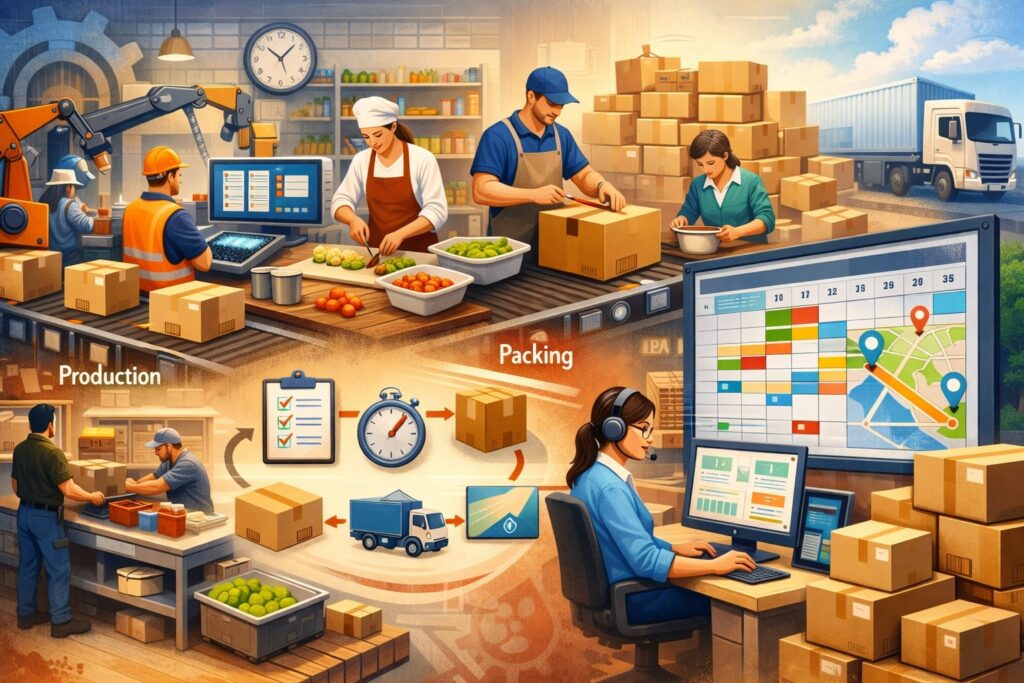
Pop-ups succeed when production is timed for freshness and holding safety. Unlike banquet catering, where service is often controlled and structured, pop-ups may face unpredictable demand spikes. That means your schedule must support rapid replenishment without chaos.
Effective catering scheduling links kitchen production to service pacing. You need to know when you’ll batch cook, when you’ll restock, and what your “par levels” are for each item. If you only cook once and hope it lasts, you risk selling out early. If you cook too much, you risk waste.
Logistics scheduling is equally critical. You must plan how food is cooled, stored, transported, and staged. Temporary events often limit cold storage and hot holding. Your plan should include exactly when items leave refrigeration, when they go into hot holding, and when they are rotated. This isn’t just best practice; it’s essential risk management.
When your production schedule is integrated into catering scheduling, your crew stops guessing. They execute a known rhythm: prep, batch, pack, load, serve, replenish, and close.
Commissary and Kitchen Workflow Scheduling
Many pop-ups rely on commissary kitchens or shared spaces. That adds new scheduling constraints: reserved time slots, shared equipment, limited storage, and rules about cleaning and trash. You must schedule around what you control and what you borrow.
In catering scheduling, build your kitchen day around “batches” and “stations.” Batch cooking reduces complexity and makes timing predictable. Station assignments prevent congestion, especially in small kitchens. If you have one oven and two cooks, you schedule oven time like a resource, not a hope.
Prep lists should be time-based, not just item-based. Instead of “prep salsa,” schedule “prep salsa 8:15–8:45, assign to Alex, using blender station.” That level of clarity is what makes catering scheduling for pop-ups and temporary events actually work. It also makes it easier to delegate to newer team members.
Finally, schedule sanitation and reset blocks. Shared kitchens may require strict cleaning and check-out steps. If you don’t schedule them, they will delay packing and loading. When cleaning is a scheduled task, you protect your departure time and reduce end-of-day friction.
Transport, Setup, and Teardown Scheduling
Temporary events are logistics-heavy. The distance may be short, but the complexity can be high due to parking limits, stairs, elevators, security checks, and restricted load-in windows. A strong catering scheduling plan treats transport and setup like a production line.
Start with packing orders. Items needed first at setup should be packed last (so they are accessible). Items needed last can be packed deeper. Label bins by zone: “front of house,” “back of house,” “POS,” “trash,” “backup inventory,” and “signage.” When packing order is aligned with your schedule, setup becomes faster.
Setup scheduling should include a zone-based sequence: power and utilities first, then tables and service line, then hot holding and cold displays, then signage and POS, then final wipe-down and test run.
Build a 10-minute “dry run” into catering scheduling where the team simulates serving one order and finds bottlenecks before guests arrive.
Teardown scheduling should be just as intentional. Assign who breaks down what, who loads the vehicle, who checks trash rules, and who verifies the site condition. Many teams lose time here because everyone is exhausted and tasks become uncoordinated. When teardown is scheduled, you leave faster and reduce damage risk.
Vendor Coordination, Permits, and Risk Management Scheduling
Pop-ups and temporary events often require extra administrative steps that traditional catering might not. You may need temporary food permits, vendor applications, fire safety approvals, or venue-specific documentation. If these steps aren’t scheduled, they become last-minute emergencies.
Strong catering scheduling includes an administrative timeline alongside the operational timeline. The admin timeline covers application deadlines, insurance documentation, menu submissions, and organizer communications.
The operational timeline covers production, staffing, and logistics. Both timelines must align, because missing paperwork can cancel an event even if your kitchen is ready.
Risk management is also scheduling. Weather contingencies, equipment backups, and supply redundancy require time to plan and stage. If your schedule is too tight, you won’t have time to handle surprises. A resilient schedule includes buffers and “decision points” where you evaluate conditions and adjust.
By treating permits, vendors, and risks as first-class tasks inside catering scheduling for pop-ups and temporary events, you reduce uncertainty and protect your revenue.
Temporary Food Permits, Inspections, and Food Safety Timing
Requirements vary by county and city, but temporary events commonly require a permit or vendor approval process through a local health department or organizer. These processes may require menu details, equipment lists, handwashing plans, temperature control plans, and sometimes an onsite inspection.
In catering scheduling, create a permit checklist with due dates: application submission, fee payment, documentation upload, and confirmation receipt. Put these dates into your timeline the same way you schedule prep and packing. Administrative work is real work.
Food safety timing must also be scheduled. Hot holding, cold holding, cooling, reheating, and transport temperature control are time-sensitive.
Build explicit “temperature checks” into your plan: pre-departure, arrival, mid-service, and close. Assign responsibility to a specific person. Scheduling these checks protects your team and your guests.
Also schedule allergen communication. Temporary events often attract new customers who don’t know your menu. Labeling, ingredient lists, and staff briefings should be scheduled tasks. When safety tasks are integrated into catering scheduling, they actually happen.
Contracts, Insurance, and Contingency Planning
Pop-ups can expose you to unique risks: property damage during setup, injuries during teardown, weather-related losses, or disputes over sales splits and responsibilities. Scheduling plays a role because you need time to review agreements, collect certificates, and align responsibilities before event day.
In catering scheduling, set contract milestones. Example: “contract signed by X date,” “deposit received by X date,” “final details confirmed by X date,” and “final payment due by X date.” This reduces cancellations and helps you plan labor and purchasing with confidence.
Insurance is often required by venues and organizers, typically as proof of coverage. Getting certificates issued can take time, especially around holidays or weekends. Schedule this early so you aren’t scrambling. If the venue requires additional insured wording, schedule time to request and confirm it.
Contingency planning should be scheduled too. If weather risk exists, schedule a decision deadline for moving indoors, adding tents, or adjusting menu items.
If equipment failure is a risk, schedule backup staging: extra extension cords, spare fuel, backup utensils, and redundant POS charging. A schedule that includes contingencies creates calm under pressure.
Technology, Communication, and Real-Time Schedule Control
Pop-ups move fast. When the line forms, you can’t stop and debate the plan. That’s why communication systems are part of catering scheduling, not an afterthought. Your schedule needs to be accessible, simple, and update-friendly.
Technology helps in two ways: planning and execution. Planning tools help you build templates, assign tasks, and track deadlines. Execution tools help you coordinate on event day with real-time changes, messaging, and checklists. The key is to pick tools that fit your team’s habits, not tools that look impressive.
Also, the best scheduling system is one your staff actually follows. That means your catering scheduling should be readable on a phone, written in plain language, and tied to checklists that are easy to confirm. Pop-ups are not the place for complicated project-management overhead.
When you combine simple tools with disciplined communication, your schedule becomes a living control system that adapts to demand and prevents small problems from becoming big ones.
Scheduling Tools, Templates, and Standard Operating Checklists
You can run pop-ups with spreadsheets and shared notes, but consistency improves when you use repeatable templates. A good catering scheduling template includes: event summary, timeline, task owners, packing list, production plan, and contact list. Even if the tools change, the structure stays stable.
Task assignment matters. Every task should have one owner. If two people own it, nobody owns it. If you want collaboration, assign an owner and a helper. This small rule dramatically improves execution because it eliminates ambiguity.
Checklists should match the timeline. A packing checklist is different from a setup checklist, and both should be tied to specific time blocks. Example: “T-minus 2 hours: load hot box, confirm fuel, pack utensils.” When checklists are time-based, catering scheduling becomes easier to execute under stress.
Finally, document improvements. After every event, update your templates with what changed: extra bins needed, longer setup times, more staff at POS, better signage placement. Over time, your catering scheduling for pop-ups and temporary events becomes a refined system rather than a repeated scramble.
Real-Time Communication During Service
The schedule doesn’t stop once service begins. During a pop-up, your plan must adapt to line volume, inventory levels, and guest behavior. That requires a simple communication rhythm.
In catering scheduling, define a “service cadence.” Example: every 15 minutes, the lead checks inventory and line speed, then decides whether to start the next batch, restock the line, or adjust menu availability. This cadence prevents reactive chaos and creates predictable decision points.
Communication should be short and standardized. Use phrases like “86 item,” “start batch,” “slow line,” “restock needed,” and “POS down.” If you use radios or group messaging, define who speaks and when. Too much messaging becomes noise.
Also schedule customer communication. If an item sells out, update signage quickly. If there’s a long wait, communicate clearly. If pre-orders are delayed, message pickup guests. When guest communication is part of catering scheduling, you protect your brand and reduce conflict.
Day-Of Execution, Quality Control, and Post-Event Optimization
Event day is where schedules either shine or collapse. The goal is not perfection; it’s control. A good catering scheduling plan gives the team a predictable rhythm, clear responsibilities, and early warning signs when something is drifting.
Execution starts with a pre-shift briefing. Confirm the run-of-show, the service model, food safety expectations, and contingency triggers. Then assign stations and confirm equipment. This briefing should be short but consistent. It aligns the crew and reduces questions later.
Quality control also needs time. Taste checks, temperature checks, portion checks, and presentation checks should be scheduled tasks, not “if we have time.” Pop-ups move fast, and quality can slip quietly. Scheduling quality checkpoints keeps standards stable.
After the event, optimization is where you gain long-term advantage. Pop-ups produce valuable data: sales by hour, waste, staffing bottlenecks, and customer feedback. When you capture that data and update your catering scheduling, each event becomes easier and more profitable.
Run-of-Show Scheduling and Service Pacing
A run-of-show is the event day timeline that everyone follows. It includes arrival times, setup steps, service start, peak planning, replenishment timing, and teardown. In catering scheduling for pop-ups and temporary events, the run-of-show is the most important document on the day of service.
Service pacing depends on line design and menu design. If the menu requires too many steps at the point of service, the line slows and the schedule breaks. Schedule a station setup that supports flow: clear menu signage, simple ordering, quick payment, efficient handoff, and a restock pathway that doesn’t block customers.
Also schedule a “soft open” period. If service starts at 12:00, aim to be ready at 11:45. Use the time to test the POS, confirm temperatures, and run a mock order. That buffer can absorb surprises without pushing you behind.
During the rush, schedule micro-actions: restock windows, trash runs, quick wipes, and batch starts. When these actions are scheduled, your team doesn’t wait until things are broken. That’s the real power of catering scheduling in temporary environments.
Debriefing, KPIs, and Forecasting for the Next Pop-Up
A debrief turns experience into a system. Without a debrief, every pop-up feels new, and your team repeats the same scheduling mistakes. Your catering scheduling should include a post-event review within 24–72 hours while details are fresh.
Track practical KPIs: sales per hour, average ticket, orders per minute during peak, labor hours, waste volume, and stockouts. Track operational notes: setup time, teardown time, equipment failures, and venue constraints. Even simple tracking makes future scheduling more accurate.
Forecasting improves when you compare similar events. A weekend festival behaves differently than a weekday retail pop-up. Over time, you can build baseline expectations and adjust schedules accordingly. That’s how catering scheduling for pop-ups and temporary events becomes predictive rather than reactive.
Also update your templates immediately. If you need two extra coolers, add it. If the teardown took 45 minutes longer, adjust. If a menu item slowed the line, simplify. Small updates compound into big gains, and soon your schedule feels effortless compared to competitors.
Future Trends and Predictions in Catering Scheduling for Pop-Ups
Pop-ups are growing because they let brands test markets, create experiences, and generate revenue without long-term leases. As demand increases, expectations rise. Customers want faster service, clearer dietary info, smoother pickup experiences, and consistent quality. That means catering scheduling will become more data-driven and more automated.
The future also favors operators who can run multi-location pop-ups with consistent standards. That requires scheduling systems that scale, not heroic individuals who “make it work.” Expect more standardized event templates, stronger integration between inventory and sales, and more dynamic staffing plans.
Sustainability and compliance will also shape scheduling. More venues are enforcing waste rules, composting, and vendor standards. More organizers are requiring documentation and operational readiness. Scheduling will expand beyond “time and people” into “time, people, compliance, and footprint.”
If you build a modern catering scheduling for pop-ups and temporary events now—templates, checklists, data capture, and adaptive control—you’ll be positioned to grow while others burn out.
AI Forecasting, Dynamic Staffing, and Smarter Prep Planning
As more sales happen through digital payments and pre-orders, pop-ups generate better demand data. That makes forecasting easier. The trend is toward tools that estimate demand by hour, suggest batch times, and recommend staffing levels based on past performance.
In practical terms, catering scheduling will shift from static timelines to flexible plans with triggers. Instead of “cook batch at 1:00,” the plan becomes “start batch when inventory hits X units or when line speed exceeds Y.” That kind of scheduling reduces waste and increases sales because you keep popular items available without overproducing.
Dynamic staffing is also coming. Operators will increasingly schedule “on-call” flex staff for high-variance events. This doesn’t mean unstable employment practices; it means building a roster of trained workers who can step in when demand exceeds forecast. When done ethically and clearly, it reduces burnout and improves service consistency.
The prediction is simple: businesses that treat catering scheduling as a data loop—plan, execute, measure, improve—will outperform businesses that treat it as a one-time planning activity.
Sustainability, Packaging Evolution, and Micro-Logistics
Sustainability pressures are pushing changes in packaging, waste handling, and supply chains. Temporary events often create a lot of packaging waste, and venues increasingly require compostable products, sorting stations, and vendor compliance.
This directly affects catering scheduling because sustainable service typically adds steps: labeling, sorting, waste runs, and supplier coordination.
Packaging evolution will also affect timing. Compostable containers can behave differently with heat and moisture. Some require ventilation to prevent sogginess. Some have limited availability and need earlier ordering.
Scheduling procurement becomes more important, especially when supply is tight or when organizers mandate specific materials.
Micro-logistics will become more common, especially for multi-pop-up operators. Instead of one big load-in, you may stage supplies closer to the event area, use smaller replenishment runs, or coordinate with local commissary partners. That changes transport scheduling and inventory planning.
The future favors teams who can build sustainable operations without slowing service. That requires more precise catering scheduling for pop-ups and temporary events, where packaging, waste, and replenishment are integrated into the run-of-show rather than handled as last-minute chores.
FAQs
Q.1: How far in advance should I build the catering scheduling timeline for a pop-up?
Answer: Build a working timeline as soon as the event is tentatively booked, then finalize it after key constraints are confirmed.
A strong approach is to create an initial schedule when you confirm service time and load-in rules, then lock purchasing and production schedules once the menu and headcount are stable. For high-variance events, keep a flexible plan with triggers and buffers instead of one rigid timeline.
Q.2: What’s the biggest mistake in catering scheduling for pop-ups and temporary events?
Answer: The most common mistake is under-scheduling setup, packing, and teardown. Teams often schedule only service hours and forget that temporary events require building a service environment from scratch.
The second biggest mistake is failing to schedule packaging and labeling, which can consume surprising labor and delay load-out.
Q.3: How do I schedule when I don’t know how many customers will show up?
Answer: Use batch cooking and par levels. Schedule initial production for a conservative baseline, then plan replenishment batches triggered by inventory levels and line speed.
Your catering scheduling should include decision points during service (for example, every 15–20 minutes) where the lead evaluates demand and starts the next batch if needed.
Q.4: Should I use pre-orders to stabilize scheduling?
Answer: Yes, pre-orders can dramatically improve catering scheduling by turning unknown demand into scheduled demand. Even limited pre-order windows help you plan production and staffing.
If you add pre-orders, schedule pickup windows, staging space, and a dedicated person to manage handoff so pre-orders don’t slow the main line.
Q.5: How do I keep my schedule from falling apart when something goes wrong?
Answer: Build buffers on the critical path, assign single owners to tasks, and keep a simple contingency plan. Your catering scheduling should include backup equipment, extra consumables, and a clear “who decides” rule. Also, schedule a soft-open window before guests arrive so you can test the system and fix issues early.
Conclusion
Pop-ups and temporary events reward operators who can execute quickly, safely, and consistently under pressure. That execution comes from a system, not luck. Catering scheduling is the system that connects your menu, your people, your production, your logistics, and your compliance into one reliable plan.
When you build schedules by backward planning, match menu complexity to capacity, design staffing roles with coverage in mind, and integrate packing, setup, and teardown into the timeline, your events become smoother and more profitable.
When you add real-time decision points and post-event debriefs, your catering scheduling for pop-ups and temporary events becomes smarter every time you run an event.
The future will favor teams who treat scheduling as a data-driven operational advantage. Whether you’re running your first pop-up or scaling a multi-event calendar, the same truth holds: a disciplined, template-based scheduling process reduces stress, protects quality, improves customer experience, and helps you grow with confidence.