Payment security for catering businesses isn’t just a “tech issue.” It’s a profit-protection system that keeps cash flow steady, prevents last-minute event disasters, and protects your reputation when you’re juggling deposits, invoices, tips, on-site card swipes, and payment links—all while delivering food on a tight timeline.
Catering has a unique risk profile. You accept large deposits weeks in advance, often take final payments on event day, and frequently collect payments on mobile devices at venues you don’t control.
That mix creates openings for card fraud, invoice scams, stolen devices, weak Wi-Fi, staff mistakes, and chargebacks. Strong payment security for catering businesses reduces those risks while keeping checkout fast for clients.
This guide breaks down the most practical, up-to-date payment security steps for catering businesses, explains the “why” behind each practice, and shares future predictions so you can stay ahead.
Why Payment Security for Catering Businesses Is Different
Payment security for catering businesses has to handle multiple payment moments: inquiry deposits, contract signatures, menu changes, final invoices, add-ons, gratuity, and sometimes bar service tabs. Each step introduces a different kind of exposure.
A traditional storefront might run most transactions through one counter terminal. Catering teams often take payments through email invoicing, hosted checkout pages, phone orders, and mobile readers at venues.
That means your payment security plan must cover office workflows and “in the field” operations—often across multiple employees and devices.
Catering also deals with higher average ticket sizes. A single compromised payment method can mean a big loss. And because events are time-bound, disputes can be messy: clients may claim services weren’t delivered “as promised,” and chargebacks can happen weeks later.
Payment security for catering businesses is therefore closely tied to documentation, contracts, receipts, and clear customer communication—not just encryption.
Finally, catering teams rely heavily on third parties: event venues, rental companies, staffing agencies, delivery partners, and sometimes online ordering tools. Every extra system that touches an invoice or stores customer contact data increases risk.
The best approach is to reduce what you store, limit who can access it, and use payment tools designed to protect sensitive card data by default.
The Most Common Payment Threats in Catering Operations
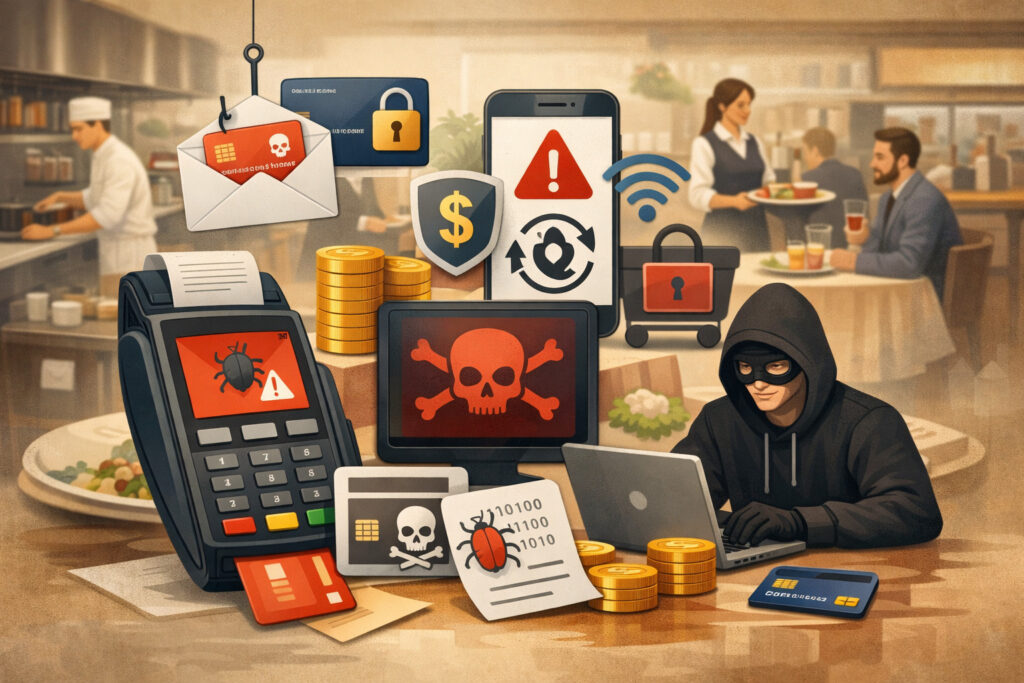
To build effective payment security for catering businesses, you need to recognize the real-world attacks that hit catering companies most often. These threats aren’t theoretical—they match how catering teams actually work.
Card-not-present fraud is a top risk because deposits and final payments may be collected via invoice links or over the phone. Fraudsters can use stolen card numbers to pay a deposit, then the real cardholder disputes it later. That becomes a chargeback plus potential fees.
Invoice redirection scams are increasing. Attackers impersonate a client or vendor and try to change bank details or payment links at the last minute. If a staff member updates a payment instruction without verification, the money goes to the attacker.
Account takeover happens when email passwords are reused or weak. If someone gets into your email, they can send “updated invoice” messages with fake payment links that look legitimate.
Device theft and skimming risks show up at venues. Mobile readers, phones, and tablets may be left unattended during setup. A stolen device can expose customer data if it’s not encrypted, locked, and remotely wipeable.
Weak Wi-Fi risk appears when staff connect to venue networks that are poorly secured. If your device is compromised or your login is intercepted, attackers can access back-office dashboards.
Practical payment security for catering businesses addresses these threats through a blend of technology (tokenization, EMV, MFA), process (verification rules, role-based access), and documentation (contracts and proof-of-service).
Mapping the Catering Payment Flow (So You Can Secure Each Step)
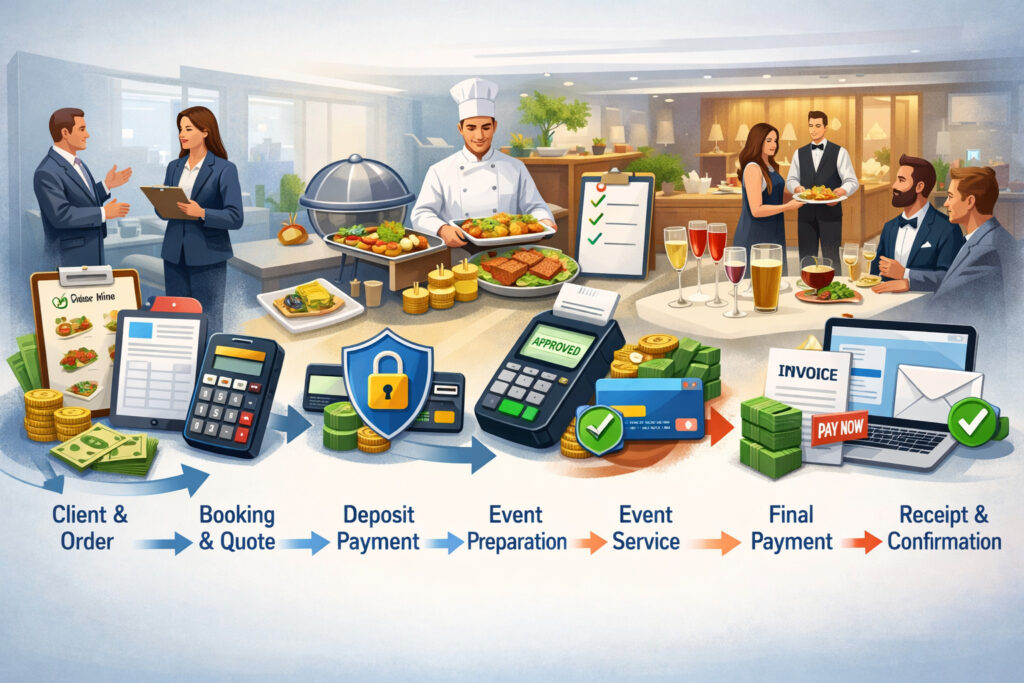
Payment security for catering businesses improves dramatically when you map your payment flow end-to-end. Most catering payment problems happen in the “gaps” between steps—like when a quote becomes a contract, or when a last-minute add-on is charged on-site.
A secure catering payment flow usually includes:
- Lead and quote: client receives pricing, packages, service terms.
- Deposit and contract: client pays a deposit and signs event agreement.
- Menu adjustments: price changes; revised invoices; add-ons.
- Final invoice: remaining balance due before event or day-of.
- Event-day payments: overtime, extra headcount, bar tabs, tips.
- Post-event reconciliation: receipts, staff payouts, accounting export.
Each stage needs controls:
- At the quote stage, prevent tampering with PDF or payment instructions.
- At deposit stage, reduce card-not-present fraud with secure checkout links.
- During revisions, ensure only authorized staff can edit invoices.
- On event day, use chip/contactless methods and secure mobile devices.
- After the event, store only what you must and keep audit trails.
This structured approach turns payment security for catering businesses into a repeatable system rather than a one-off checklist.
PCI Compliance: The Non-Negotiable Foundation for Card Payments
If you accept card payments, PCI DSS matters. Payment security for catering businesses starts with understanding your responsibilities under the PCI Security Standards—especially if you accept deposits online and take card payments in person at venues.
PCI DSS v4.0.1 is the active version, and many “future-dated” requirements became mandatory after March 31, 2025. This matters because catering businesses often use web-based tools, payment links, and scripts that can be targeted by attackers.
PCI’s updated direction places more emphasis on continuous security, stronger authentication, and protecting payment pages from tampering.
The most important PCI lesson for catering: avoid storing card data. Don’t keep card numbers in spreadsheets, email threads, notes apps, or saved in invoicing systems unless you are using approved tokenization methods. When you reduce stored payment data, you reduce breach exposure and compliance burden.
A practical PCI approach for catering:
- Use a payment provider that offers hosted payment pages or secure payment links so sensitive card details never touch your systems.
- Enable multi-factor authentication (MFA) on payment dashboards.
- Keep devices updated and protected, especially tablets used at events.
- Maintain an inventory of systems that touch payments (POS, invoicing, CRM).
Strong PCI alignment is one of the fastest ways to level up payment security for catering businesses without slowing down sales.
Card-Present Security at Events: Chip and Contactless Done Right
When you collect payments on-site, payment security for catering businesses depends on chip and contactless acceptance—not manual entry whenever possible. EMV chip transactions reduce counterfeit card fraud by using dynamic data per transaction.
There’s also the practical business side: with chip acceptance widely expected, businesses that fail to use EMV-capable devices may face increased liability for certain counterfeit fraud scenarios (often called the “liability shift”). For catering, this matters when you take a high-dollar final payment at a venue.
Best practices for event-day card-present payment security:
- Use EMV and contactless-enabled readers and train staff to avoid fallback to swipe.
- Never accept card numbers written on paper for “quick later entry.”
- Require signatures or ID checks only where it fits your policy and local rules, but don’t rely on ID checks alone as fraud protection.
- Disable unnecessary permissions on the device running your payment app.
- Lock down your mobile devices with strong passcodes and auto-lock.
A strong on-site setup means your payment security for catering businesses doesn’t collapse during the busiest, most chaotic moments of an event.
Invoice and Payment Link Security: Protecting Deposits and Final Balances
Invoices are a major vulnerability in payment security for catering businesses because they travel through email, where attackers love to operate. A single fake “updated invoice” message can redirect thousands.
Make your invoice process harder to spoof:
- Use branded, hosted invoices generated by your payment provider rather than attaching editable documents.
- Configure invoice emails to come from a consistent domain and format.
- Put a verification rule in place: any request to change payment instructions must be confirmed via a second channel (phone call to a known number, not a number in the email).
- Keep invoice permissions tight so only a few people can create or edit invoices.
Payment link safety tips:
- Prefer hosted checkout links that show your business name clearly.
- Avoid sending payment links through unprotected channels when possible.
- Add invoice numbers and event dates inside the hosted payment experience to reduce “I didn’t authorize this” disputes.
This is where payment security for catering businesses overlaps with customer experience. The easier it is for clients to recognize a legitimate invoice, the less likely they’ll fall for impersonation—and the less likely you’ll deal with chargebacks.
Tokenization and Why It’s a Big Deal for Catering Businesses
Tokenization is one of the strongest upgrades you can make to payment security for catering businesses. In simple terms, tokenization replaces sensitive card data with a randomized value (a token) so your systems don’t store actual card numbers.
Network tokenization, supported by major card networks, is designed to reduce fraud and improve approval rates because the real card details aren’t exposed in the same way. For catering, this is especially useful for repeat clients, corporate accounts, or customers who book multiple events per year.
How tokenization helps in real catering workflows:
- You can take a deposit today and charge the remaining balance later without storing card numbers in unsafe places.
- You can process add-ons or last-minute upgrades securely if your system supports token-based “card on file.”
- If your invoicing tool gets compromised, tokens are far less valuable to attackers than raw card data.
When evaluating providers, ask if they offer:
- Network tokenization or strong vault/token systems
- Secure customer profiles
- Fine-grained access control (who can charge a saved payment method)
Tokenization turns payment security for catering businesses into a default behavior rather than a constant manual effort.
Access Control, Staff Training, and Role-Based Permissions
Most payment incidents in small service businesses come from human error: clicking phishing links, sending invoices to the wrong address, sharing logins, or using personal devices with weak security. Payment security for catering businesses needs clear roles, not “everyone uses the same password.”
Role-based access control should match how your team works:
- Sales staff: create quotes and invoices, but cannot change bank details.
- Event managers: view event payments and collect on-site balances, but cannot refund large amounts without approval.
- Accounting: reconciliation, exports, refunds within policy.
- Owner/admin: permission changes, payout settings, high-risk actions.
Training must be simple and repeated:
- Teach staff to recognize fake invoice-change requests.
- Teach “no card numbers in email or text” as a non-negotiable rule.
- Practice what to do if a device is lost at a venue.
- Use password managers and require MFA wherever available.
You don’t need a huge IT program. You need habits. And habits are a major pillar of payment security for catering businesses because attackers often target the easiest human mistake.
Securing Mobile Devices, Apps, and Venue Networks
Because catering teams operate on the move, mobile security is central to payment security for catering businesses. Your phone or tablet is a payment terminal, an email inbox, and a client database—so it must be protected like one.
Mobile device best practices:
- Enable full-device encryption (default on most modern phones).
- Require strong passcodes and biometric unlock.
- Turn on remote wipe and “find my device” features.
- Keep operating systems and payment apps updated.
- Avoid installing unnecessary apps on devices used for payments.
Venue network safety:
- Do not assume venue Wi-Fi is secure.
- Use cellular data or a dedicated hotspot when possible.
- If you must use venue Wi-Fi, avoid logging into sensitive admin dashboards over unknown networks.
This is where payment security for catering businesses can prevent a silent failure: the kind where everything “seems fine” until accounts are drained or invoices are hijacked.
Fraud Prevention and Chargeback Defense for Catering Businesses
Even with great payment security, disputes happen. Chargebacks are common in catering because services are experiential and expectations can be subjective. The goal is to reduce fraud-driven chargebacks and win legitimate disputes with strong evidence.
Fraud prevention tactics:
- Require deposits through secure, traceable channels.
- For higher-risk situations, request additional verification (matching billing info, signed contract before charging final balance).
- Avoid manual card entry unless necessary; it typically increases risk.
Chargeback defense basics:
- Use clear event contracts with cancellation and refund terms.
- Include line-item descriptions (menu, headcount, staffing, rentals).
- Keep delivery confirmations and event-day sign-offs.
- Save communication logs about changes and approvals.
- Provide receipts and proof of service completion.
A well-built process reduces “friendly fraud,” where a customer receives the service but disputes the charge anyway. Strong documentation is an underrated part of payment security for catering businesses because it protects revenue after the event ends.
Cybersecurity Framework Thinking for Smaller Catering Teams
You don’t need enterprise security jargon, but a simple framework helps. NIST’s Cybersecurity Framework 2.0 emphasizes a full lifecycle approach and adds a “Govern” function to strengthen oversight.
Translated for payment security for catering businesses, a lightweight version looks like this:
- Govern: decide who owns payment security decisions (owner, ops lead, or finance lead).
- Identify: list systems that handle payments (invoice tool, payment gateway, mobile readers).
- Protect: MFA, access control, device security, tokenization.
- Detect: alerts for payout changes, failed login attempts, unusual refunds.
- Respond: plan for device loss, suspected fraud, compromised email.
- Recover: restore access, rotate credentials, notify stakeholders if needed.
Framework thinking keeps you from focusing only on checkout technology while ignoring email security, staff workflows, and incident response—areas where many real payment breaches begin.
Incident Response: What to Do If Something Goes Wrong
Payment security for catering businesses isn’t complete without a “bad day plan.” When an incident happens, speed and clarity matter more than perfection.
Create a simple incident response checklist:
- Contain: disable affected accounts, lock devices, stop suspicious payouts.
- Preserve evidence: don’t delete emails; export logs if possible.
- Notify your payment provider: they can help investigate, freeze risky activity, and guide next steps.
- Reset access: rotate passwords, enable MFA, remove unknown users.
- Communicate carefully: contact clients only with verified information if invoices were compromised.
Common catering-specific incidents include:
- A staff email account gets phished.
- A payment dashboard shows a payout account change.
- A mobile device is lost at a venue with payment apps installed.
- Clients report receiving “new payment links” you didn’t send.
The strongest payment security for catering businesses accepts that incidents can happen and builds muscle memory to respond without panic.
Future Predictions: Where Payment Security for Catering Businesses Is Headed
Payment security for catering businesses is evolving quickly because fraud tactics are evolving quickly. Several trends are likely to shape the next few years.
- More tokenization everywhere: Network tokenization and token management services are expanding to reduce exposure in digital payments. Catering businesses will increasingly benefit from “secure card-on-file” models that reduce risk while supporting deposits, installments, and add-ons.
- Stronger standards and continuous compliance: PCI updates push businesses toward ongoing security hygiene rather than annual checkbox compliance, and future guidance will likely continue moving in that direction.
- More attacks targeting email and invoicing workflows: As chip/contactless reduces some counterfeit fraud, attackers shift toward business email compromise and invoice manipulation. Catering, with high-dollar invoices and last-minute changes, is an attractive target.
- More built-in fraud tools in payment platforms: Expect better anomaly detection for refunds, payout changes, and unusual invoice patterns—especially as small businesses demand protections that used to be enterprise-only.
If you build payment security for catering businesses around tokenization, MFA, secure invoicing, device controls, and documentation, you’ll be aligned with where the industry is heading.
FAQs
Q1) What is the fastest way to improve payment security for catering businesses?
Answer: Enable MFA on your email and payment dashboards, switch to hosted invoices/payment links, and stop storing card numbers anywhere. Those three steps reduce the most common real-world risks immediately.
Q2) Should catering businesses accept payments over the phone?
Answer: You can, but it increases risk. If you must, use a secure virtual terminal from a reputable provider and follow strict rules: never write card numbers down, never store them, and limit who can access the virtual terminal. For better payment security for catering businesses, push clients toward secure payment links whenever possible.
Q3) Is contactless payment safe at events?
Answer: Yes. Contactless and chip payments are designed to reduce certain types of fraud compared to magstripe swipe. The key is using approved devices and keeping your mobile environment secure. EMV and contactless security are core elements of payment security for catering businesses.
Q4) How do I prevent “fake invoice” scams?
Answer: Use hosted invoices, consistent branding, and a strict verification policy for any payment detail changes. Train staff to confirm changes via a known phone number. Payment security for catering businesses depends heavily on invoice workflow discipline.
Q5) Do I need to be PCI compliant if I use a payment processor?
Answer: Usually yes, but your responsibilities may be reduced if you use hosted payment pages and don’t store card data. PCI compliance requirements can vary based on how you accept payments and what systems touch card data. PCI DSS v4.0.1 and the March 31, 2025 deadline for future-dated requirements are important reference points.
Q6) What’s the best way to handle deposits and final payments securely?
Answer: Use a provider that supports deposits, installment billing, and tokenization so you don’t store sensitive card information. Tokenization helps secure digital payments by replacing sensitive details with tokens.
Conclusion
Payment security for catering businesses is about more than preventing fraud. It’s about protecting revenue, keeping events running smoothly, and ensuring clients trust your business with high-dollar transactions.
The strongest payment security for catering businesses is built on a few repeatable pillars:
- Use hosted payment links and avoid storing card data
- Adopt chip and contactless payments for on-site transactions
- Use tokenization for deposits, installments, and repeat clients
- Lock down access with MFA and role-based permissions
- Secure mobile devices and avoid risky venue networks
- Document services clearly to defend chargebacks
- Maintain an incident response plan so you can react fast
If you implement these steps, you’ll reduce fraud exposure, improve authorization success, and run a more resilient catering operation—without making checkout harder for clients.