By cloudcateringmanager January 20, 2026
Catering is an “everything, everywhere, all at once” business: leads arrive by phone, web forms, and referrals; menus change by season and dietary needs; staffing shifts by venue rules; and every event has its own timeline, deposits, add-ons, and last-minute surprises.
That complexity is exactly why catering software with integrated payment solutions has become a must-have instead of a nice-to-have. When your proposals, contracts, invoices, deposits, and final balances live in one system—and the payments flow through the same platform—you reduce mistakes, speed up cash flow, and gain clarity on profitability per event.
At a practical level, catering software with integrated payment solutions combines two worlds: the operational side (menus, scheduling, production, staffing, delivery, inventory, customer communication) and the money side (card-present and card-not-present payments, ACH, invoices, refunds, chargebacks, reporting, reconciliation, and payouts).
The best systems don’t just “accept payments.” They help you collect deposits on time, reduce no-shows, automate reminders, handle partial payments, and keep event changes synchronized with billing.
This guide breaks down what catering software with integrated payment solutions should include, how to evaluate vendors, how to implement successfully, and what’s changing in security and payment technology.
You’ll also find future-looking predictions—because the next few years will bring faster payment rails, new compliance expectations, and more automation across catering operations.
What “Catering Software with Integrated Payment Solutions” Really Means
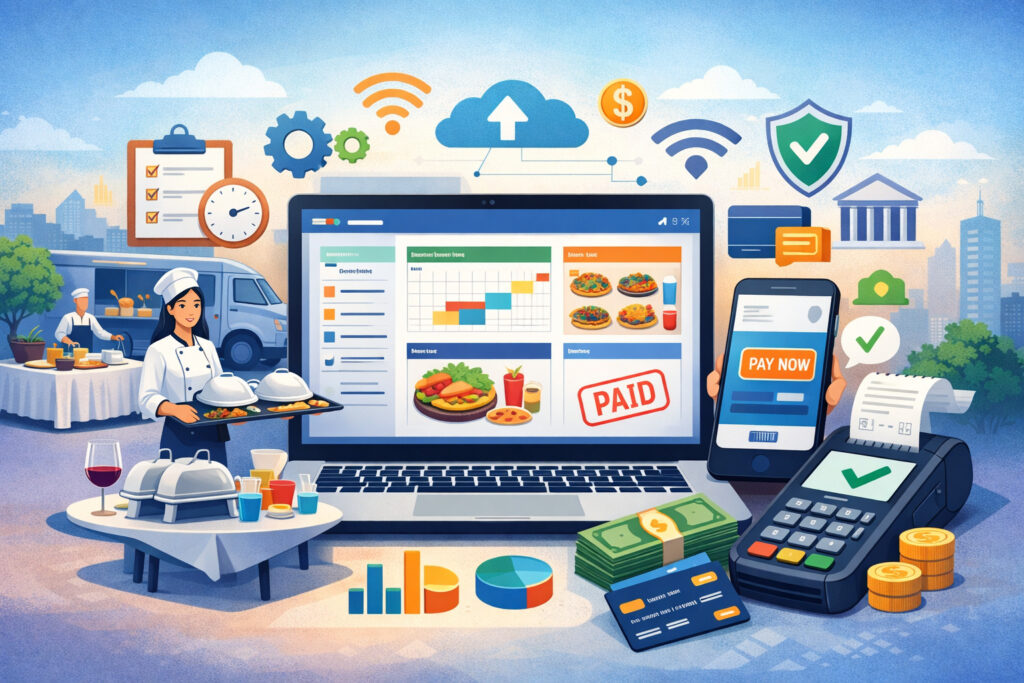
Catering software with integrated payment solutions is not simply a catering app plus a link to a payment gateway. True integration means the payment layer is embedded into the workflow so that financial actions happen because operational steps happen.
Example: when a client signs a digital contract, the system can automatically request a deposit, accept payment immediately, update the event’s balance, and log the transaction against that event without manual data entry.
In day-to-day terms, catering software with integrated payment solutions should let you build a quote, convert it into a contract, generate an invoice schedule (deposit, progress payment, final), and collect those payments through the same interface your team already uses for event planning.
If the guest count increases or a premium add-on is approved, the updated total should flow into the invoice—without someone exporting a spreadsheet and re-keying totals.
The “integrated” part also includes unified reporting. Instead of reconciling event revenue in one place and payment deposits in another, catering software with integrated payment solutions ties everything together: event ID, customer profile, invoice number, payment method, processing fees, tips (if applicable), refund status, and payout timing.
Finally, integration should improve customer experience. When clients can pay a deposit from the proposal page, split a balance across multiple cards, or use a secure hosted pay link, catering software with integrated payment solutions helps you close deals faster and reduce friction—especially for corporate clients with strict purchasing workflows.
Core Catering Modules That Must Connect to Payments
A strong operational foundation is what makes catering software with integrated payment solutions truly valuable. Start with a CRM that captures lead source, event type, budget range, decision timeline, and preferences.
Then you need quoting/proposal tools with customizable templates, optional add-ons, and version control—because catering quotes change constantly.
Next come the production essentials: menu management with ingredient scaling, dietary tags, and package pricing; event timelines and task lists; staffing assignments; delivery logistics; and inventory/ordering support. If you run multiple kitchens or partner venues, scheduling rules and location-based prep lists matter.
Here’s the key: each module should push accurate financial triggers. When the proposal is approved, it should generate the correct invoice schedule. When the client adds a late-night snack station, the platform should update the balance and prompt payment if needed.
When an event is canceled within a policy window, the system should guide the correct refund or retained deposit handling. That’s the “glue” that separates generic tools from real catering software with integrated payment solutions.
In the best platforms, the event record becomes the single source of truth: guest count, menu, labor, rentals, taxes/fees, and every payment and payout. That alignment protects margins and reduces the most common catering problem—small errors that quietly add up across dozens of events.
What “Integrated Payments” Includes (Beyond Swiping a Card)
When evaluating catering software with integrated payment solutions, it helps to define the payment capabilities you actually need.
Most caterers require a mix of card-not-present (invoices, deposits, remote approvals) and card-present (tastings, pop-up events, venue add-ons, on-site bar service). Integration should support both without forcing separate merchant accounts or duplicate customer profiles.
“Integrated payments” also means multiple rails and experiences: secure pay links, customer portals, emailed invoices, SMS reminders, stored payment methods (tokenized), and scheduled auto-charges for installment plans.
For business clients, ACH bank transfer options can lower fees and reduce card limits for large balances. For smaller quick payments, digital wallets and contactless acceptance speed things up.
Strong catering software with integrated payment solutions also includes the “after-payment” layer: automated receipts, payment status syncing, refund workflows, dispute/chargeback visibility, and detailed payout reporting that helps your bookkeeper match deposits to events.
Security and compliance are part of the definition too. You want tokenization (so sensitive card data isn’t stored on your servers), role-based access, audit trails, and support for modern payment security requirements.
If your catering business sells online (even just through invoice pay links), the platform should align with current PCI expectations and protect payment pages from tampering, which has become a bigger focus under newer PCI guidance.
Why Integrated Payments Matter for Caterers
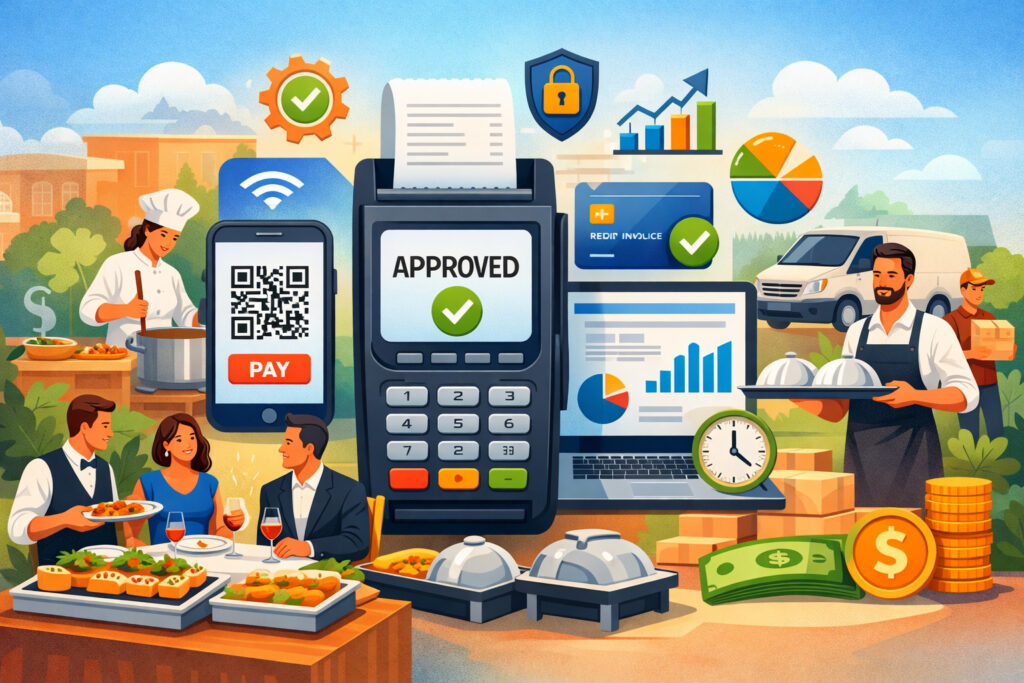
Catering is uniquely exposed to payment complexity: you collect deposits far in advance, final balances close to the event date, and adjustments happen right up to service time. That’s why catering software with integrated payment solutions can directly increase revenue—not by “selling more,” but by capturing what you’ve already earned, faster and more accurately.
One immediate benefit is fewer missed deposits. When the system automatically issues an invoice and reminder schedule the moment a proposal is accepted, clients are less likely to delay. Another benefit is fewer accounting errors.
If payments automatically map to the correct event and invoice, you don’t end up with mismatched balances or awkward follow-ups asking clients to re-check what they paid.
Integrated payments also improve client trust. People feel safer paying through a professional portal attached to the contract they just signed. Corporate clients appreciate consistent documentation: invoice numbers, receipts, and clear status tracking.
With catering software with integrated payment solutions, “Can you resend the invoice?” turns into “Here’s your portal—everything is there.”
Most importantly, integrated payments help margin control. When last-minute upgrades and service changes update billing automatically, you’re less likely to absorb costs accidentally. In catering, preventing a few “small misses” per month can mean the difference between a healthy profit and a stressful season.
Faster Sales Cycles, Cleaner Deposits, and Smoother Event-Day Changes
Speed matters in catering. Many leads are shopping for multiple vendors, and whoever responds professionally—and makes next steps easy—often wins. Catering software with integrated payment solutions can turn a lead into a booked event in one flow: proposal → e-signature → deposit payment. That creates momentum and reduces drop-off.
Deposits are also where friction shows up. Clients may want to split a deposit across two cards, pay via ACH, or get an invoice that matches their internal process. Integrated systems make these options part of a standard workflow rather than a special request you handle manually.
On event day, changes happen: extra guests, upgraded rentals, added bar hours, or on-site add-ons. With catering software with integrated payment solutions, you can generate an immediate balance update and accept payment on the spot (or send a link instantly). That reduces post-event collection headaches and helps you avoid carrying receivables longer than necessary.
Refunds and cancellations also get cleaner. Instead of hunting through processor dashboards, a unified view lets you see the original payment, apply policy rules consistently, and issue refunds with documentation tied to the event record.
Cash Flow, Payout Timing, and Reconciliation That Doesn’t Break Your Brain
Cash flow is oxygen for catering—especially when you front food costs, staffing, rentals, and venue fees. Catering software with integrated payment solutions helps you forecast cash because you can see scheduled invoices, expected payment dates, and outstanding balances by event week.
Reconciliation becomes dramatically easier when payouts and transactions are tied to events. You want to answer questions like: “Which events funded this week’s payroll?” and “Why is there a payout shortfall?” Integrated reporting helps because you can break down each deposit: gross sales, refunds, chargebacks, fees, and net payout.
It also helps you spot operational issues. If a certain type of event consistently has late payments, you can adjust deposit rules. If chargebacks cluster around certain invoice behaviors, you can tighten your documentation and signature flow.
Finally, modern payment rails are moving toward always-on expectations. Instant payment networks are expanding and are designed for 24/7/365 transfers. The Federal Reserve has emphasized that FedNow supports around-the-clock instant payments and continues to grow adoption.
For caterers, this points to a near future where payout speed and vendor payments can become more flexible—if your platform is ready.
Essential Features Checklist for Catering Software with Integrated Payment Solutions
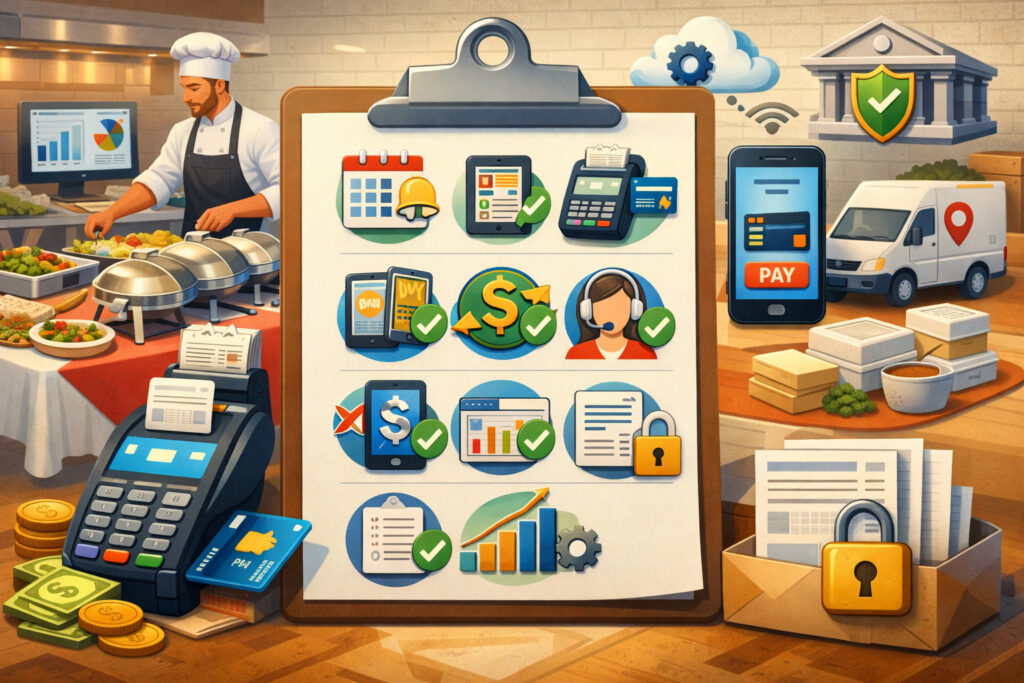
Choosing catering software with integrated payment solutions is easiest when you evaluate outcomes: fewer manual steps, fewer mistakes, better client experience, and better visibility into profit.
Features matter, but only if they solve those outcomes in your environment—whether you run drop-off catering, full-service events, corporate recurring orders, weddings, or a hybrid model.
At minimum, you want a proposal builder that supports packages, per-person pricing, rentals, service fees, and taxes, with clear “optional add-ons” and approval tracking. Then you want contracts with e-signature, policy acknowledgments (cancellation, minimums, venue rules), and a payment schedule tied to milestones.
On the payment side, catering software with integrated payment solutions should support deposits, partial payments, recurring billing (for corporate accounts), pay links, and mobile acceptance. It should also support roles and permissions so a sales rep can send invoices while finance controls refunds and account settings.
Reporting is not optional. You need event-level profitability views (revenue minus food, labor, rentals, and processing fees), sales pipeline dashboards, and payment status snapshots for upcoming event weeks.
Finally, integrations matter: accounting platforms, email/SMS, payroll scheduling, delivery routing, and inventory management. The more your platform can connect cleanly, the less your team lives in spreadsheets.
Event Lifecycle Automation: From Lead to Proposal to Paid Invoice
A defining feature of catering software with integrated payment solutions is lifecycle automation. The goal is to remove the “handoff gaps” where deals stall or details get lost.
Start with lead capture: web forms should create a lead record, tag the source, and prompt follow-ups. Next, proposal creation should pull data into a template that reflects your brand and pricing logic. When a client requests changes, versioning matters so you can see what changed and why.
Once the client approves, the system should automatically generate the contract and invoice schedule. Deposit requests should go out immediately, with reminders if unpaid. When payment arrives, the event status should update, and production planning should reflect the event as confirmed.
If your business supports corporate accounts, catering software with integrated payment solutions should handle purchase orders, invoicing terms, and consolidated billing. This is where integration pays off: the system can track outstanding balances while still maintaining operational readiness for each event.
Automation also reduces staff burnout. Instead of chasing signatures and payments manually, your team focuses on client experience and execution quality.
Mobile-First Operations for Tastings, Venues, and On-Site Add-Ons
Catering happens outside the office. That’s why catering software with integrated payment solutions should be mobile-friendly, not “desktop-only with a squished screen.”
A strong mobile workflow lets you pull up an event record at a tasting, confirm menu selections, update guest counts, and collect a deposit or tasting fee immediately. On event day, mobile access helps supervisors confirm timelines, communicate changes, and handle last-minute purchases without paperwork.
For payments, mobile acceptance can mean dedicated card readers, contactless acceptance, or phone-based tap-to-pay options supported by your payment app.
Apple’s guidance for Tap to Pay on iPhone describes accepting contactless payments directly on an iPhone through a supported payment app. EMVCo also documents EMV Mobile as supporting secure contactless payments and merchant acceptance on mobile devices.
Offline and poor-signal resilience is another mobile reality. While you may not process a payment fully offline, you can still capture intent, save changes, and sync once connected. The more dependable mobile workflows are, the more catering software with integrated payment solutions supports real-world catering.
Accounting, Tax Readiness, and Clean Records for Busy Seasons
Finance is where messy systems become expensive. Catering software with integrated payment solutions should support clean accounting outputs: tax breakdowns, service charges, tips (when applicable), discounts, refunds, and fees—exportable in formats your accountant actually wants.
Sales tax can be complex across different states and localities, especially when you serve multiple venues or sell taxable items alongside services. A good platform helps you apply the right tax logic consistently and keeps an audit trail.
Payment reporting should also support documentation needs around payment settlement reporting rules. The IRS publishes Form 1099-K FAQs and updates them regularly, which is relevant if you receive payments through certain settlement entities and need clear records for goods/services reporting questions.
Even if a form is not issued in a specific case, accurate records help you file correctly and respond to client or accountant questions.
The point isn’t to turn your catering platform into a full accounting suite. The point is that catering software with integrated payment solutions should produce reliable, consistent, export-ready financial data—so tax season doesn’t feel like a reconstruction project.
The Payment Technology Stack Behind Catering Software with Integrated Payment Solutions
If you want to choose the right catering software with integrated payment solutions, it helps to understand what’s happening under the hood.
You don’t need to be a payment engineer, but you do want enough clarity to ask smart questions: How are card details handled? Where does tokenization occur? What security standards are supported? How do disputes flow? How do payouts reconcile?
Most systems involve a payment processor (the rails to card networks and banks), a payment gateway or API layer (how transactions are initiated), and a token vault (where sensitive card details are replaced with tokens).
Your catering platform may bundle these into a single “integrated” offer (often called embedded or integrated payments), or it may connect to a third-party processor.
The advantage of a unified approach is that the platform can tie transactions to events natively—making catering software with integrated payment solutions simpler for your staff.
The risk is vendor lock-in if pricing or support becomes an issue. That’s why you evaluate not only features but also portability: Can you export customer and invoice data? Can you change processors without rebuilding everything?
Understanding the stack also helps you plan for future changes. Payment security standards evolve, mobile acceptance methods expand, and real-time payment rails increasingly influence expectations for payouts and vendor payments.
EMV, Contactless, Tap-to-Pay, and Modern On-Site Acceptance
For on-site collection, catering software with integrated payment solutions should support modern acceptance methods that clients expect: chip (EMV), contactless, and wallet-based payments.
EMVCo describes EMV Mobile as supporting secure contactless payments and merchant acceptance on mobile devices using NFC technology. For caterers, this matters because you might accept payments at a tasting, a venue walk-through, or a corporate event add-on.
Tap-to-pay options also reduce hardware friction. Apple’s Tap to Pay on iPhone guidance explains that merchants can accept contactless payments using only an iPhone through a supported payment app.
If your catering team is frequently in the field, this can reduce device management headaches—provided your processor and app support it. Contactless is not just convenient; it can speed up lines, reduce handling, and improve the perception of professionalism.
The most important evaluation point is whether mobile acceptance is truly integrated into your event and invoice records—because catering software with integrated payment solutions is only as good as how well it ties on-site transactions to the correct event.
PCI DSS 4.0, E-Commerce Payment Page Security, and What Changed Recently
Security is a ranking factor for trust, even if it isn’t an SEO keyword. Clients want confidence that payments are handled safely. And from a business standpoint, security compliance reduces the risk of fines, chargebacks, and brand damage.
PCI DSS version 4 introduced many changes, with “future-dated” requirements becoming mandatory after March 31, 2025, according to PCI Security Standards Council communications and related guidance. PCI-focused compliance summaries also emphasize stronger authentication expectations and additional e-commerce protections.
Why does this matter for catering software with integrated payment solutions? Because even if you’re not running a traditional online store, invoice payment links and hosted payment pages are part of e-commerce. Modern PCI attention includes protecting payment pages from script tampering and ensuring you have visibility and controls over what runs on those pages.
In practical terms, look for tokenization, hosted fields or hosted checkout options (reducing your scope), strong admin access controls, and vendor documentation that clearly explains how they meet current PCI expectations. The right vendor will help you reduce PCI burden—not increase it—while keeping payments smooth for clients.
Fraud Prevention, Disputes, and Chargeback Readiness Built Into the Workflow
Disputes often come down to documentation. Catering software with integrated payment solutions should help you win disputes by making proof easy: signed contracts, cancellation policy acknowledgments, delivery confirmations, event notes, and communication logs tied to the transaction.
Fraud prevention also includes basic hygiene: AVS and CVV checks for card-not-present transactions, device fingerprinting where available, velocity limits (to prevent repeated attempts), and smart risk flags (like mismatched billing info).
But catering is not one-size-fits-all; a wedding deposit and a corporate recurring order look different. Your platform should let you tune controls without blocking legitimate customers.
Refund workflows matter too. If a client disputes because they couldn’t get a clear refund status, that’s preventable. Integrated systems can show pending refunds, partial refunds, and policy-driven refund amounts so your team gives consistent answers.
The strongest catering software with integrated payment solutions treats disputes as part of the customer journey—not a separate “processor problem.” When finance can see the same event record as sales and operations, responses become faster and more accurate.
How to Choose the Right Catering Software with Integrated Payment Solutions
Selecting catering software with integrated payment solutions is a business model decision, not only a software decision. The platform you choose will shape how you price, how you collect deposits, how you manage receivables, and how you measure profitability.
So your evaluation should include operations, finance, and leadership—because “best for sales” and “best for bookkeeping” are not always the same.
Start by mapping your top 3 revenue streams: weddings, corporate lunches, social events, drop-off, concessions, or venue partnerships. Then ask: does the platform support your workflow without forcing workarounds?
A wedding-heavy caterer needs rich proposals, add-on management, and timeline clarity. A corporate caterer needs repeat ordering, invoicing terms, and account-level controls.
Then evaluate payments. Is it truly integrated? Can you collect deposits immediately from the proposal? Can you store payment methods safely (tokenized) for future charges? Can clients pay via ACH if desired? Are refunds and partial payments easy?
Finally, consider vendor strength: onboarding, support, uptime, and roadmap. Catering software with integrated payment solutions should feel like infrastructure, not an experiment.
Pricing Models: SaaS Fees, Processing Costs, and Revenue Protection
With catering software with integrated payment solutions, you typically pay software subscription fees plus payment processing costs. The tricky part is that the “bundle” can hide trade-offs.
Common structures include a flat monthly SaaS fee plus transaction fees, or a lower SaaS fee paired with higher processing margin. Some platforms offer interchange-plus, while others offer tiered or blended pricing.
You should ask for a pricing worksheet that reflects your real mix: average ticket size, deposit frequency, keyed vs. card-present ratio, and monthly volume swings.
You should also evaluate policies around refunds, chargebacks, and payout timing. If your business relies on deposits to fund season prep, payout delays can hurt. If you do high-ticket events, fee transparency matters because small rate differences can mean thousands over the year.
If you’re considering surcharge, cash discount, or dual-pricing approaches, confirm the platform supports it cleanly and compliantly—without confusing invoices. Even if you choose not to use these, catering software with integrated payment solutions should support flexible fee handling and clear customer-facing displays.
Implementation and Support: Migration, Integrations, and Operational Fit
Software transitions fail more often from change management than from features. When implementing catering software with integrated payment solutions, ask vendors how they handle migration: importing customer lists, templates, menus, pricing packages, and historical event records.
Integration readiness is equally important. If you rely on accounting software, payroll scheduling, delivery routing, email marketing, or venue management tools, confirm whether the integrations are native, partner-based, or custom API work. “We integrate” can mean many things.
Support matters most during busy weeks. Ask about live support hours, response times, and escalation paths. Ask what happens during a payment outage or an account underwriting issue. A vendor that treats payments as core infrastructure (not an add-on) is usually more reliable for catering software with integrated payment solutions.
Also ask about the roadmap: are they investing in mobile improvements, real-time reporting, and security updates? Payment standards and customer expectations change quickly. You want a provider that stays current.
Implementation Blueprint: Rolling Out Catering Software with Integrated Payment Solutions Successfully
Even the best catering software with integrated payment solutions won’t deliver results if it’s implemented as “install it and hope.” Catering businesses are workflow-driven, and the software has to match how you actually sell, plan, produce, and deliver events.
A successful rollout starts with process mapping. Identify who owns lead intake, who builds proposals, who approves pricing, who schedules staff, who closes invoices, and who handles refunds.
Then configure roles and permissions to match. A common failure is giving everyone full access “for convenience,” which leads to inconsistent pricing, messy notes, and refund risk.
Next, build templates and standards. Your proposal templates, package rules, deposit policies, and cancellation language should be consistent. When the system is consistent, clients trust it more—and staff spends less time debating exceptions.
Finally, do structured testing. Run several “fake events” through the full flow: lead → proposal → contract → deposit → change order → final invoice → payment → payout → refund simulation. That’s how catering software with integrated payment solutions becomes predictable before you put real customers through it.
Mapping Workflows, Roles, and Event Types Before You Configure Anything
Before you configure menus, make sure you configure decision-making. Catering software with integrated payment solutions should reflect your internal rules: who can discount, who can approve custom menu pricing, who can trigger refunds, and who can change tax/service fee settings.
Segment by event type. Weddings often need longer timelines, tasting workflows, milestone payments, and extra documentation. Corporate accounts might need net terms, PO fields, and consolidated billing. Social events might need faster quote-to-book speed with standardized packages.
Define the financial workflow per segment: deposit percentage, due dates, late fees (if used), and how change orders are handled. Then configure the system so the “default path” matches your business. If staff constantly overrides settings, the system isn’t aligned.
This step is where catering software with integrated payment solutions delivers the biggest payoff: standardized workflows reduce human error and create a professional, repeatable client experience.
Testing Payments End-to-End: Deposits, Refunds, Chargebacks, and Payout Matching
Payment testing should be more than “a card went through.” With catering software with integrated payment solutions, test the full lifecycle:
- Deposit payment via invoice link
- Partial payments split across methods
- ACH payment (if offered)
- Refunds (full and partial)
- Voids vs refunds timing rules
- Dispute documentation exports
- Payout reporting and event-level reconciliation
Also test edge cases: event reschedule, cancellation with retained deposit, and last-minute add-ons collected on-site. These are the situations where real operations get messy.
Confirm how fees appear in reporting. Some platforms show gross sales and fees separately; others show net deposit postings. Your bookkeeper should understand how the platform reports so monthly close doesn’t become detective work.
When this is done well, catering software with integrated payment solutions becomes a reliable financial engine rather than a black box.
Training and Change Management That Sticks Through Peak Season
Training is not a one-hour webinar. For catering software with integrated payment solutions, your team needs role-based training: sales, operations, finance, and managers.
Sales needs mastery of proposals, contract flows, and deposit collection. Operations needs event timelines, production reports, staffing, and day-of updates. Finance needs invoice logic, refund workflows, payout reconciliation, and reporting exports.
Create quick reference guides for the most common actions: sending a deposit invoice, generating a change order, collecting a payment at a tasting, issuing a partial refund, and marking an event paid. Use short checklists and real examples.
Then reinforce with audits: review a sample of events each week for pricing consistency and payment status accuracy. Integrated systems make this easier because catering software with integrated payment solutions gives you centralized visibility—use it to keep standards high.
Advanced Use Cases and Industry Trends for Catering Software with Integrated Payment Solutions
Once your basics are stable, catering software with integrated payment solutions can become a growth platform. This is where you unlock automation, faster settlement options, better forecasting, and more sophisticated sales strategies.
Advanced use cases often start with corporate growth: account-level pricing, recurring orders, subscription-style catering (weekly lunches), and consolidated billing. Then you extend into customer experience: self-service portals, reordering, and personalization based on past preferences.
Operationally, advanced use means tighter inventory and labor control. When menu changes update ingredient projections and staffing needs, you reduce waste and overtime. Financially, advanced use means faster collections and better insight: profit per menu package, profit per venue, and conversion rate per lead channel.
The most forward-looking catering software with integrated payment solutions is also preparing for faster payment rails and more flexible payout options, which can change how caterers manage vendor payments and staffing cash needs.
Instant Payout Expectations and the Shift Toward Always-On Payments
Traditional bank settlement isn’t always aligned with catering reality. You may have high expenses on a weekend event, but payouts land days later. That’s why there’s growing interest in instant and always-on payment capabilities.
The Federal Reserve notes that the FedNow Service is live and supports instant payments any time of day, any day of the year, and continues to grow adoption. The FedNow resource materials also describe broad use cases for instant payments.
For caterers, the practical future is not “everything becomes instant tomorrow.” It’s more like: select payouts, vendor payments, refunds, and emergency transfers become faster where banks and platforms support it.
Over time, catering software with integrated payment solutions may offer optional instant payout features, especially for businesses that want better weekend cash flow flexibility.
If this matters to you, ask vendors about their roadmap for real-time payment rails and instant disbursements, and how they manage risk while offering faster access to funds.
Omnichannel Catering: Online Ordering, Event Portals, and Venue Partnerships
Catering increasingly blends events and commerce. Clients want easy reordering, clear portals, and quick approvals. Venues want preferred vendor collaboration. Corporate admins want repeatable ordering with budget tracking.
This is where catering software with integrated payment solutions shines: a client portal that shows proposals, invoices, and payment status in one place. Online ordering for drop-off catering can connect to the same customer record used for full-service events. Venue partners can receive standardized BEOs and timelines.
The advantage is consistency. A customer who ordered a corporate lunch can later book a holiday party and see a familiar payment experience. A venue partner can trust that deposits and policies are managed professionally.
When evaluating platforms, confirm that omnichannel doesn’t mean “two separate systems.” The whole point of catering software with integrated payment solutions is one source of truth across every sales channel.
AI Forecasting, Smart Menus, and Margin Protection as the Next Competitive Edge
AI in catering isn’t about replacing chefs. It’s about predictions and guardrails. The next wave of catering software with integrated payment solutions will use data to forecast demand, suggest menu quantities, flag low-margin packages, and predict staffing needs based on historical patterns.
Smart systems can also flag pricing risks: “This event has a low margin compared to similar events,” or “Your rental costs increased but the invoice didn’t update.” Integrated payments strengthen this because you get real financial outcomes tied to each event.
Expect more automation around follow-ups too: smarter reminder timing, predictive lead scoring, and suggested upsells based on client type and past behavior.
The future-proof move is choosing catering software with integrated payment solutions that already has strong reporting and clean data structures—because AI features only work when the underlying data is accurate.
Future Predictions: Where Catering Software with Integrated Payment Solutions Is Headed
The next few years will likely reshape both catering operations and payments. Client expectations continue moving toward mobile-first, instant confirmations, and frictionless checkout.
Security requirements continue tightening around online payment experiences. And software platforms are increasingly bundling payments as part of their core business model.
One big shift is deeper embedded finance. Instead of “software + payments,” platforms will increasingly offer financing options, instant payouts, vendor payment tools, and richer cash flow forecasting.
For a caterer, that could mean easier short-term liquidity planning during peak season and smoother vendor settlement for rentals and venue fees.
Another shift is device-driven acceptance. Mobile contactless acceptance is expanding, and platform support for tap-to-pay methods will keep improving. Apple publicly positions Tap to Pay on iPhone as a way to accept contactless payments through supported apps, reducing hardware dependence.
As these changes accelerate, catering software with integrated payment solutions will become less about “software features” and more about operational resilience: stable checkout, clear compliance posture, flexible payout options, and data-driven decision support.
Embedded Finance, Tokenization, and Passwordless Security Becoming Standard
Tokenization is already common, but it will become even more central. More platforms will default to tokenized stored payment methods for deposits and installment plans, improving conversion while reducing risk.
Passwordless security (like passkeys) is also spreading across business applications. For catering teams, this matters because staff turnover and seasonal hiring increase account risk. Expect catering software with integrated payment solutions to add stronger identity controls, better device management, and more granular audit trails.
We’ll also see more “unified commerce” experiences: one platform supporting invoices, in-person acceptance, online ordering, and subscription-style catering—all tied to one customer profile and one reporting layer. The caterers who benefit most will be the ones who standardize processes early, so the platform can automate without chaos.
Compliance Evolution After PCI DSS 4.0 and What to Watch Next
PCI requirements have been evolving toward stronger authentication and stronger e-commerce protections, with future-dated requirements becoming mandatory after March 31, 2025. Even if you rely on hosted payment pages, you should expect vendors to ask for tighter operational controls and more documented security practices.
Privacy expectations are also rising. Digital receipts, customer portals, and marketing integrations mean more customer data in your systems. Future catering software with integrated payment solutions will likely add better consent management, data retention controls, and clearer audit logs.
The winning approach is choosing vendors who publish clear security documentation and proactively update tools. Compliance shouldn’t be something you scramble for once a year; it should be built into the platform’s ongoing maintenance.
FAQs
Q.1: What is the biggest advantage of catering software with integrated payment solutions for small catering businesses?
Answer: For small teams, the biggest advantage of catering software with integrated payment solutions is eliminating manual handoffs. When one person is wearing five hats—sales, planning, invoices, and operations—every duplicate step becomes a risk.
Integration removes repetitive tasks like copying totals into an invoice tool, checking a processor dashboard for deposits, and manually updating event status.
It also improves speed. Many small caterers win deals by responding quickly and making booking easy. A proposal that converts to a contract with an immediate deposit payment option reduces friction and helps you secure the date faster.
Finally, it improves professionalism. Clients see a consistent process: branded proposal, clear contract, secure payment method, instant receipt, and an accessible portal.
That builds trust, which is especially important when clients are paying large deposits months ahead of the event. In short, catering software with integrated payment solutions helps small caterers operate like larger organizations—without needing extra staff.
Q.2: Do I need card readers, or can catering software with integrated payment solutions work with mobile tap-to-pay?
Answer: Many modern setups can support both. Catering software with integrated payment solutions often supports traditional card readers (useful for reliability and certain acceptance needs), but mobile tap-to-pay options are increasingly available through supported payment apps.
Apple explains that Tap to Pay on iPhone allows merchants to accept contactless payments using an iPhone through a payment app that supports it. EMVCo also describes EMV Mobile enabling secure contactless payments and mobile acceptance.
In practice, some caterers keep one or two readers for peak reliability and use tap-to-pay for supervisors or offsite tastings. The key is integration: whichever method you use, catering software with integrated payment solutions should tie the transaction to the correct event and invoice so your books stay clean.
Q.3: How do I reduce chargebacks when using catering software with integrated payment solutions?
Answer: Chargebacks are usually won or lost on documentation and clarity. With catering software with integrated payment solutions, your first defense is a strong contract flow: e-signature, clear cancellation policy, service details, and acknowledgments for non-refundable deposits when applicable.
Next, keep events that change history. If the guest count increased or add-ons were approved, you want a timestamped record. Then ensure receipts and payment confirmations are automated and easy for clients to find—confusion leads to disputes.
Operational proof helps too: delivery confirmation, venue check-in notes, staffing logs, and communication records tied to the event. When a dispute happens, your response is stronger if catering software with integrated payment solutions lets you pull a single event packet: contract, invoice, payment confirmation, and event notes.
Finally, reduce surprises. Make taxes, service fees, gratuities, and rental policies transparent on proposals and invoices. Many disputes begin as “I didn’t recognize this charge,” which good formatting and clear line items can prevent.
Q.4: What security and compliance questions should I ask vendors offering catering software with integrated payment solutions?
Answer: Ask how they reduce your PCI scope. The vendor should explain whether they use hosted checkout, tokenization, and secure payment fields so your systems don’t store sensitive card data. Ask how they handle admin access, role permissions, and audit logs.
Also ask how they address current PCI expectations. PCI Security Standards Council communications highlight that PCI DSS v4.0.1 includes future-dated requirements that become mandatory after March 31, 2025.
If your clients pay through invoice links or hosted pages, ask what protections exist against payment page tampering and how the vendor monitors or controls scripts and changes.
Ask about incident response: how quickly they notify merchants if an issue occurs, what logs are available, and what support you get during disputes or fraud spikes.
In short, catering software with integrated payment solutions should make security easier for you—not push the burden onto your team.
Conclusion
Choosing catering software with integrated payment solutions is one of the most practical upgrades a catering business can make because it aligns the two things that decide success: flawless execution and predictable cash flow.
When proposals, contracts, invoices, deposits, and final payments live in one connected workflow, you reduce missed steps, close sales faster, and keep event profitability visible.
The best approach is to evaluate platforms by how they handle your real-life catering moments: last-minute guest count changes, deposit deadlines, venue-specific requirements, corporate billing needs, mobile tastings, refunds, and reconciliation. If catering software with integrated payment solutions can’t handle those smoothly, features won’t matter.
Implementation is where value is won. Map workflows first, configure event types and rules, test payments end-to-end, and train by role. Once your foundation is stable, you can unlock advanced use cases like omnichannel ordering, deeper reporting, and future-ready payout options influenced by the growth of instant payments networks.
Looking ahead, catering software with integrated payment solutions will keep moving toward embedded finance, mobile-first acceptance, stronger security expectations, and more AI-driven margin protection.
Caterers who adopt a unified platform now—and standardize how they sell and bill—will be in the best position to grow with less friction, fewer errors, and more confidence every season.